Deck & Outdoor Living Questions · Composite Systems · Colorado Front Range
Colorado Deck Questions, Answered System by System
A deck is more than surface boards — it is a foundation, a frame, a ledger, decking, and railing working as one system. Here are the real questions Colorado homeowners ask about composite decks, fire-rated builds, pergolas, and patio covers, answered by the installation team that builds them.
Composite & PVC Decking Materials
What is composite decking made of?
Traditional composite blends wood fibers with recycled plastics under a protective cap. The newer generation goes further: mineral-based composites like Deckorators’ Surestone core replace wood fiber with stone-polymer material that absorbs virtually no moisture — rated for ground and even water contact — while running roughly 35% lighter than traditional composites. Full PVC boards like TimberTech Advanced PVC drop organic content entirely: nothing to swell, mold, or rot. Those three tiers — wood-plastic composite, mineral composite, and PVC — are the modern decking conversation.
What are the disadvantages of composite decking?
Honest list: upfront cost is real — composite systems price well above wood on day one and only win the math over years of skipped staining and repairs. Standard composites can run warm in full Colorado sun (board choice and color manage this — PVC runs up to 30° cooler to the touch). Cheap composite from a decade ago earned the category some scars: sagging, chalking, fading. Today’s mineral-core and capped boards solved most of it, but they solved it at the premium end — which is why board selection matters more than brand slogans.
Trex vs. TimberTech — which is better?
Both are excellent capped composites, and the honest difference is emphasis: Trex leads on recycled content and value tiers; TimberTech leads on moisture protection (most lines capped on all four sides) and its Advanced PVC flagship, which stays cooler and carries the strongest fade-and-stain warranties in the category. We install both — plus Deckorators, which many homeowners haven’t met yet and often ends up winning the comparison. Side-by-side details on our brand comparison page.
What is Deckorators Surestone — and why do you quote it so often?
Surestone is Deckorators’ mineral-based composite core: stone-polymer instead of wood fiber, so the board barely absorbs moisture and won’t swell, soften, or rot. It is about 35% lighter than traditional composite yet stronger underfoot, with 34% more traction wet or dry — a real consideration on Colorado stairs in March. The warranty tells the confidence story: 50-year structural, 25-year stain and fade, and a 25-year labor warranty — the piece most decking warranties quietly leave out.
Which composite decking stays coolest in the sun?
PVC boards win the heat question: with no wood fiber and lighter mineral fillers, boards like TimberTech Advanced PVC stay up to 30° cooler to the touch than dense traditional composites — the difference between bare feet and flip-flops in July. Color matters just as much: light and mid-tone boards run meaningfully cooler than dark ones on every product line. West-facing Colorado decks at altitude get intense afternoon sun, so we bring board samples that have been sitting in it — your feet make the final call.
Is a Trex deck worth it?
Compared to wood in Colorado — yes, and the math is lifecycle, not sticker: no staining or sealing ever, no splinters, no rot, and hail-and-UV performance wood can’t match at altitude. Whether Trex specifically is worth it over TimberTech or Deckorators depends on the line and your priorities; the brands trade wins on heat, traction, and warranty. Our composite vs. wood deck comparison walks the full ownership math.
What is the downside of Trex decking?
The fair critiques: entry-level Trex lines are capped on three sides rather than four, dark colors get hot in full sun like every dense composite, and scratch repairs on any capped board mean living with it or replacing the board — there is no sanding it out. None of these are disqualifiers; they are line-selection questions. This is exactly why we carry three manufacturers instead of one: the right board for a shaded north-side deck is the wrong board for a bare south exposure.
Fire-Rated & WUI Decking
What does a Class A fire rating mean for decking?
Class A is the highest flame-spread rating a decking material can earn — it measures how the material itself behaves under fire exposure, and it is the rating wildland-urban interface codes reference — but the code does not disqualify composite below Class A. Colorado’s 2025 wildfire resiliency code carries an explicit exception: a minimum Class B rating qualifies composite decking. It is the most misread line in the code, and the clause that lets quality composite boards comply. Several premium boards, including TimberTech’s fire-rated lines, achieve it, and non-combustible steel and aluminum framing goes further — Class 1A structure that isn’t a coating but the material itself. Which rating your project actually needs depends on your address, which is why we confirm the code before designing. Full options on our fire-rated & WUI deck page.
Should deck framing be steel or aluminum in a WUI zone?
Either is a genuine upgrade over wood where embers are the threat — both are non-combustible, and both stay dimensionally stable through Colorado’s freeze-thaw swings. Light-gauge steel framing is factory-straight, won’t warp, twist, split, sag, or shrink, and delivers a flatter, squarer deck that stays that way. Aluminum is the lightest premium substructure we build, immune to rot, rust, and insects. In fire country we pair either with fire-rated decking and ember screening so the whole assembly — not just one component — resists ignition.
What is ember-resistant deck screening?
Fine stainless metal mesh — 1/8-inch openings — closing off the under-deck area so wind-blown embers can’t collect beneath the deck, which is exactly where wildfire takes homes. It is real, code-recognized protection in Colorado’s fire country, built low-profile into the structure rather than bolted on afterward. Combined with non-combustible framing and Class A decking, it turns the deck from a home’s most vulnerable attachment into part of its defense.
Does my deck have to meet WUI code?
Only your address answers that. Foothills jurisdictions — Jefferson County’s Wildfire Resiliency Code, Boulder County’s wildfire rules, and similar regulations — can govern decking materials, substructure, and under-deck screening, while a plains address a few miles east may face no requirements at all. Two practical notes: codes are tightening across the foothills with each adoption cycle, and insurers increasingly reward ignition-resistant construction regardless of what code requires. We confirm the requirements for your specific address as the first step of every foothills deck design. The full picture — adoption dates, Class 1 vs Class 2, and the 25% rule — is in our Colorado Wildfire Resiliency Code guide.
What is the safest decking for wildfire-prone areas?
Think in assemblies, not boards: fire-rated Class A decking over non-combustible steel or aluminum framing, with stainless ember mesh enclosing the underdeck — that combination addresses flame spread, structural ignition, and ember intrusion together. A Class A board on a dry wood frame over an open ember trap is a rating on paper, not protection. This assembly approach is exactly how we build in Evergreen, Boulder’s foothills, and other WUI communities — and it is why fire-area homeowners find us. Two more specs worth demanding, and no board escapes them: the rating has to survive weathering — wood-plastic composites are retested after accelerated weathering (ASTM D7032), with peak heat release allowed to rise no more than 10% — and the zone under the deck stays empty, because stored firewood defeats an assembly no rating can save.
The Deck System: Foundation to Framing
What is a deck actually made of, beneath the boards?
Working up from the ground: foundations (concrete caissons, Diamond Pier footings, or helical piers depending on soil and load), structural posts, a ledger connecting the deck to the house, the frame of joists and beams, then the decking surface, fascia, railing, and stairs. Every failed deck we replace failed below the boards — rotted ledgers, undersized footings, corroded fasteners — which is why our design conversation starts at the foundation and works up, not at the board color and down.
What is a deck ledger, and why does the material matter?
The ledger is the structural board bolted to your house that carries one entire side of the deck — and ledger failure is behind most catastrophic deck collapses. Pressure-treated wood ledgers can warp, shrink, and rot at exactly the connection that matters most. We offer a full ladder: kiln-dried treated lumber, LVL, aluminum, and triple-coated galvanized steel that won’t warp or rot, handles long spans, and carries up to a 50-year warranty — and we pair the ledger material to the frame, steel with steel, aluminum with aluminum.
Is steel deck framing worth it under a composite deck?
For many of our builds, yes — and comfort is the underrated reason. Composite boards last 25–50 years, but a wood frame under them keeps moving: warping, twisting, shrinking, opening squeaks and soft spots the boards faithfully telegraph. Factory-straight light-gauge steel gives a flatter, squarer deck that feels the same in year 20 as on day one — the frame you install today is the frame you’ll have decades from now. Matching the substructure’s lifespan to the decking’s is just honest engineering.
Do I need engineered plans and a permit for a deck in Colorado?
Essentially every Front Range jurisdiction requires a permit for a new deck, and most projects benefit from engineer-stamped structural plans — we handle both start to finish, with plans verified by a licensed engineer and ready for your building department. Stamped plans aren’t bureaucracy; they are what prevents surprises at inspection, validates snow-load design (a real number in Colorado), and protects the investment. Plans, permitting, and our production queue are also why deck projects reward early starts — the clock begins when the design is approved.
What is an underdeck system?
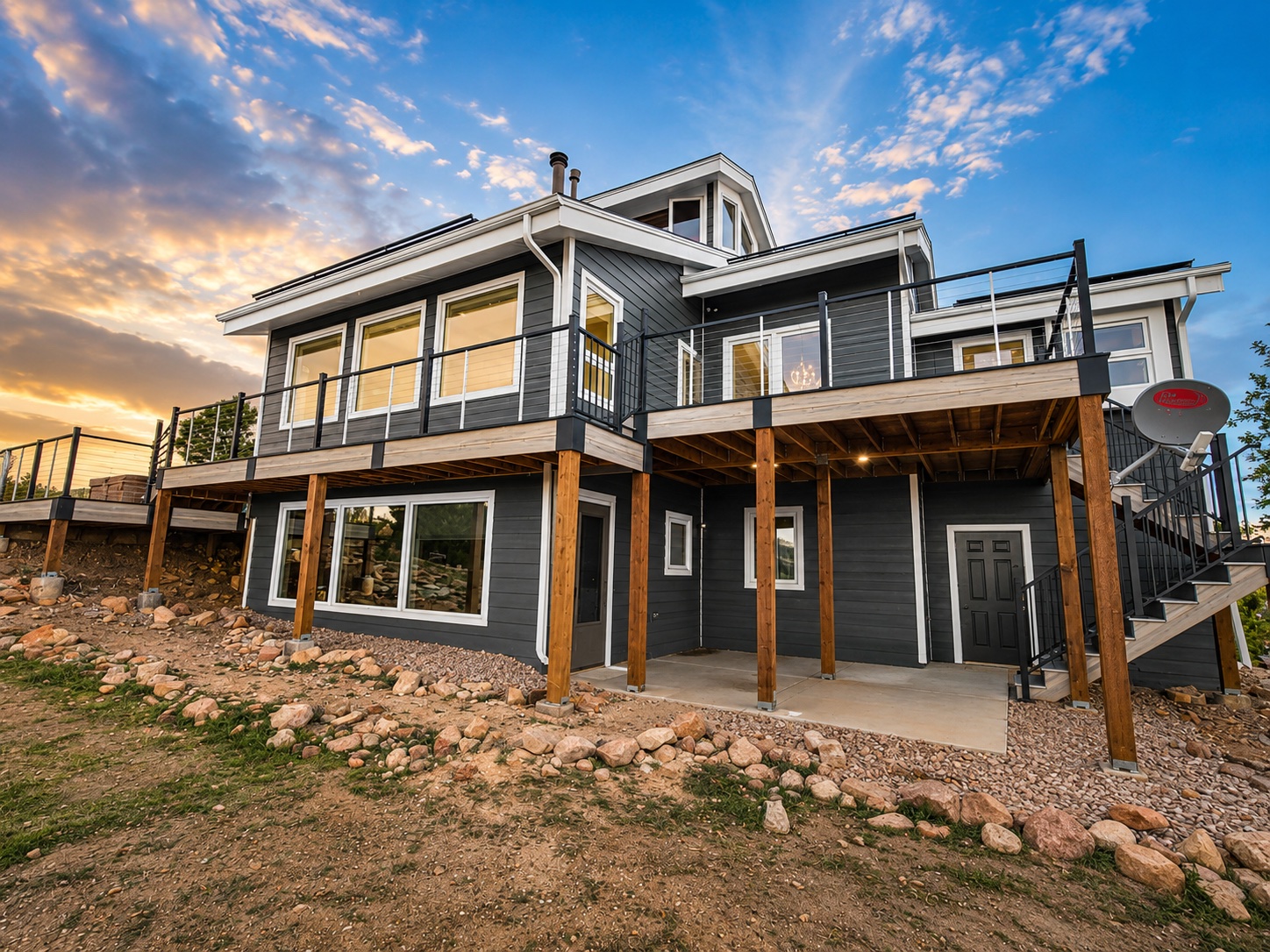
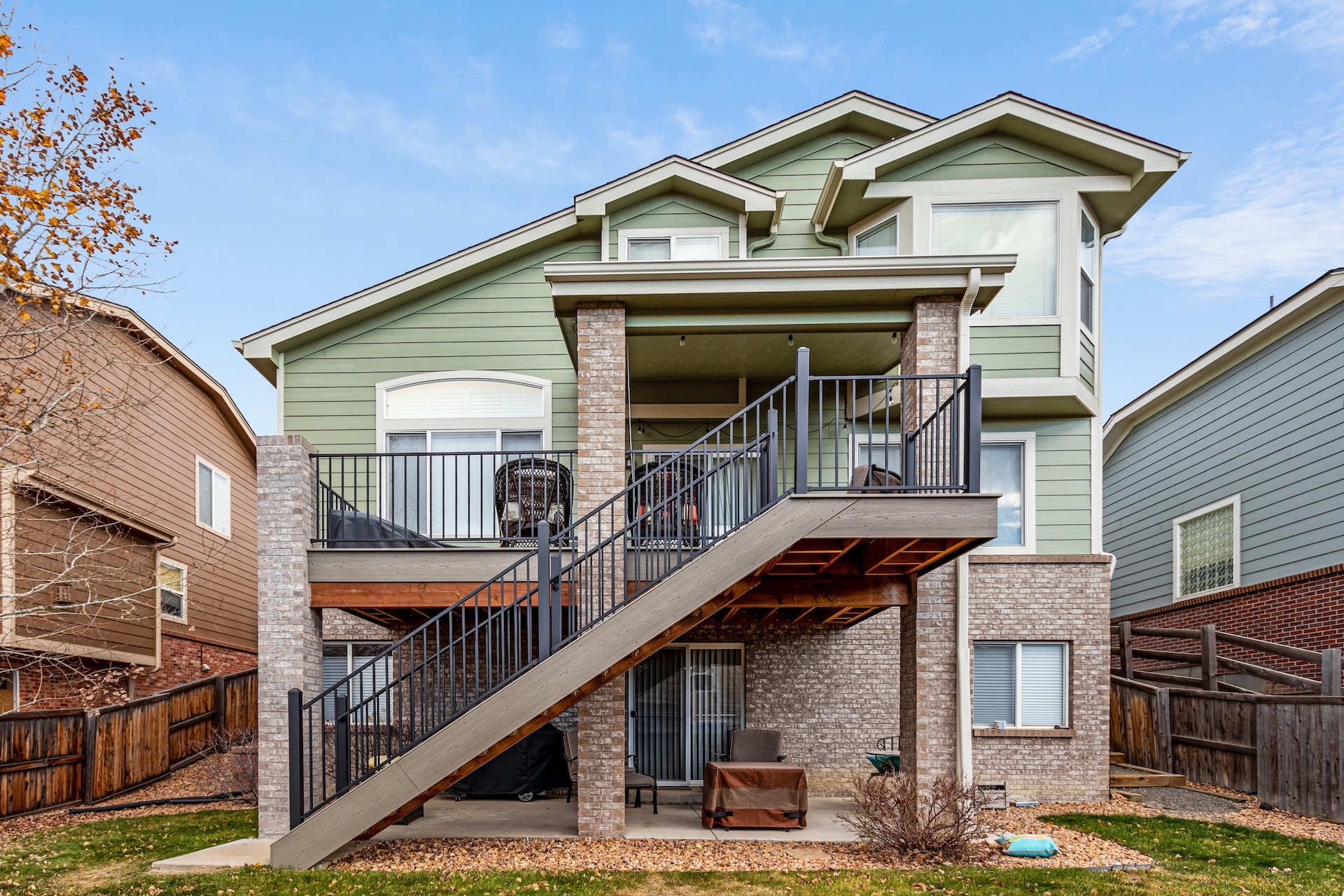
Found square footage: on a raised deck, an underdeck drainage system catches water that falls through the boards and sheds it away, turning the space below into a dry, usable patio — effectively doubling the outdoor living area of the same footprint. Rain sheds off above while you stay dry below, and the space takes lighting, fans, and furniture like any covered patio. If your deck stands tall enough to walk under, you already own the space; the system just makes it livable.
What is a cocktail rail?
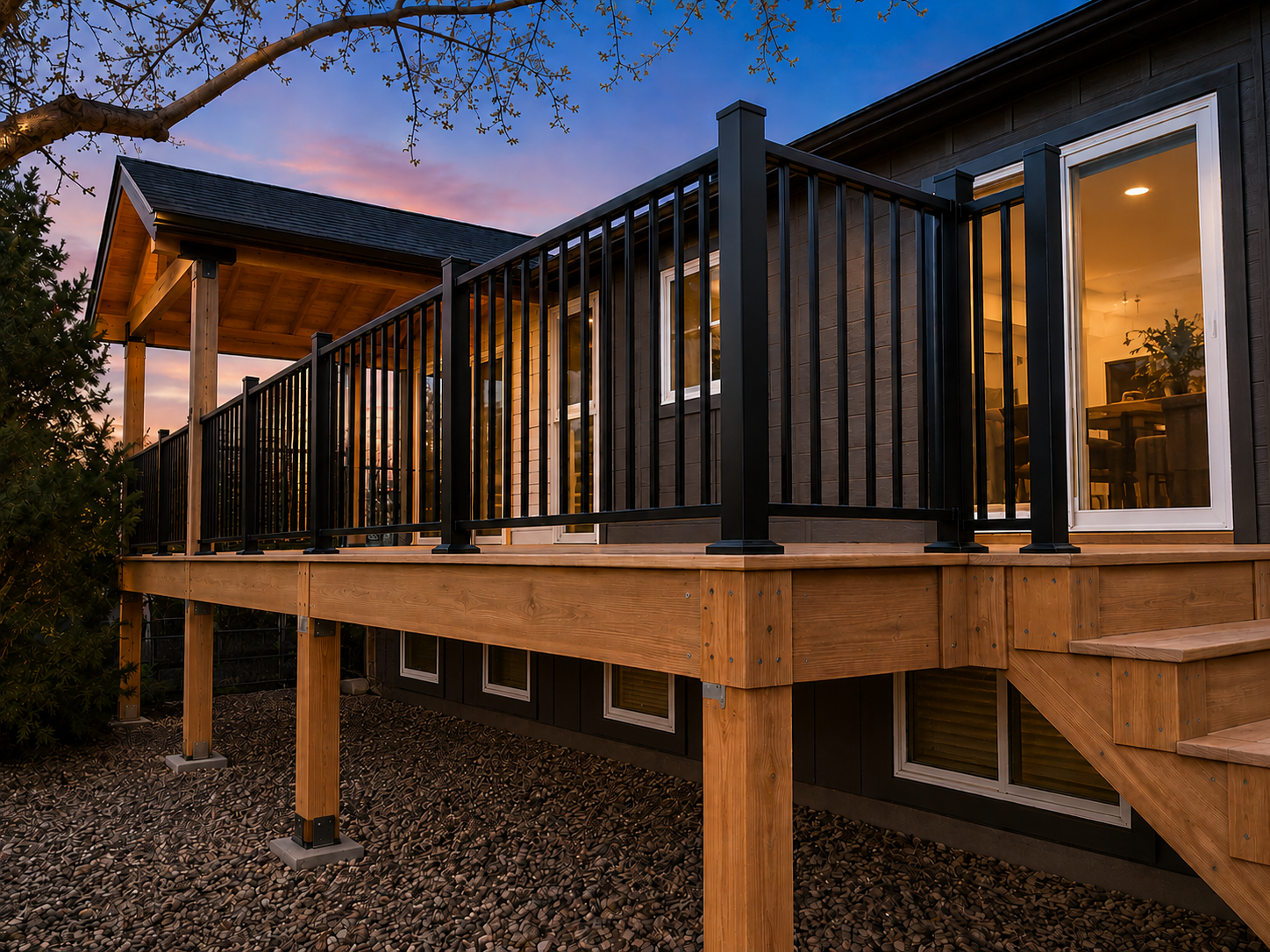
A flat, drink-rail top cap on the railing, finished in your actual decking board — TimberTech decking gets a TimberTech cocktail rail, Deckorators gets Deckorators — so it matches the deck perfectly. It adds a usable ledge for drinks and plates along the entire railing without taking up a square inch of deck space, and it is one of the highest satisfaction-per-dollar options we install. Small detail, used every single evening the deck is.
Deck Railings
What deck railing options are there beyond standard pickets?
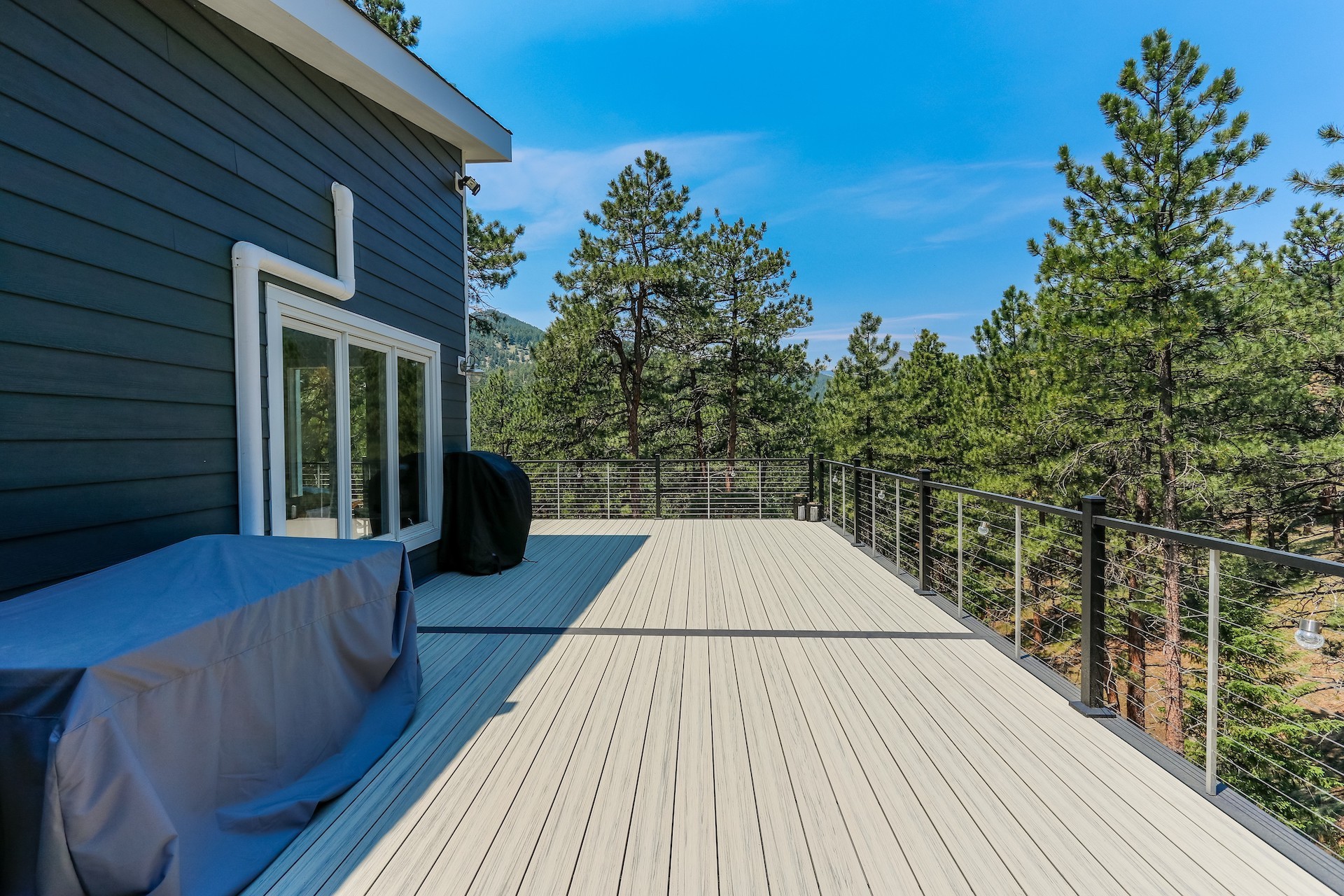
The full menu we install: powder-coated steel and aluminum panel systems (TimberTech Fulton, Deckorators ALX), stainless cable railing that keeps sightlines open with a modern edge, thin steel rod rail (Trex Signature), and frameless glass for the view lots where the railing should disappear entirely. Railing is roughly a third of how a deck looks and a real share of its cost, so it deserves the same comparison energy as the boards — and mixing systems (glass on the view side, panels elsewhere) is fair game.
Is cable railing safe and code-compliant?
Yes, when built as a system: properly tensioned marine-grade stainless cables at code spacing, on posts engineered for the tension load, meet residential guard requirements while keeping the view wide open. The failure mode is DIY cable on posts never designed for it — cables loosen, spacing spreads, and the guard stops guarding. Installed as an engineered system it is rust-resistant, low-maintenance, and built to stay taut through Colorado’s temperature swings.
How tall does a deck railing have to be in Colorado?
Residential code generally requires a 36-inch guard on any deck surface more than 30 inches above grade, with infill that rejects a 4-inch sphere — that spacing rule is why cable tension and picket gaps matter as much as height. Stairs carry their own handrail requirements. Local amendments vary by jurisdiction, and a low platform deck under 30 inches may need no guard at all (though many homeowners want one anyway) — we design to your jurisdiction’s exact code as part of the stamped plans.
Deck Cost & Value
How much does a composite deck cost in Colorado?
Custom decks are quoted, not priced from a chart — but the honest framing: a professionally built composite deck is a five-figure project, and the range is set less by square footage than by the system choices: foundation type, wood vs. steel vs. aluminum framing, decking tier (traditional composite to mineral-core to PVC), railing selection, stairs, and height. Second-story and mountain-area builds add real structural cost. We quote line-item, so you see exactly which choices drive your number — and financing is available.
How much does a 12×12 or 20×20 composite deck cost?
The honest answer to every “cost for my size” question: a 12×12 (144 sq ft) and a 20×20 (400 sq ft) of the same system differ far less than two 20×20 decks with different systems. A ground-level 20×20 on wood framing with basic composite and simple railing can cost half of the identical footprint elevated on steel framing with PVC boards and cable rail. Size sets the floor; foundation, height, frame, board tier, and railing set the ceiling. Bring us the footprint and we’ll price the versions side by side.
Is composite cheaper than wood over time?
Wood wins the first check; composite usually wins the decade. A wood deck in Colorado wants re-staining every couple of years, plus board replacements as UV, hail, and freeze-thaw take their share — costs and weekends that never stop. Composite’s premium buys out all of it: no staining, no sealing, no rot, warranties running 25 to 50 years. Add resale — buyers read a composite deck as an amenity and a wood deck as a chore — and the lifecycle math is why we build composite exclusively. Full comparison in our composite vs. wood guide.
Does a new deck add value to a Colorado home?
Outdoor living space is among the most consistently valued exterior improvements in Colorado — our climate delivers 300 sunny days that make a deck genuinely usable most of the year, and buyers price that in. The value shows up three ways: appraisal contribution, faster sales for homes with finished outdoor space, and the years of use before any sale. Low-maintenance composite protects that value; a deck that needs restaining by year three does the opposite of adding value at showing time.
Pergolas, Patio Covers & Porch Roofs
What is the difference between a pergola and a patio cover?
A pergola has an open or slatted roof — filtered shade, sky visible, the architectural feature of the backyard. A patio or porch cover carries a solid roof, often tied into the house roofline, giving true weather protection: shade in July, dry chairs in a September hailstorm. The middle ground is a louvered system that opens and closes. Which one fits depends on how you’ll use the space — dining wants solid cover; a hot-tub or lounge zone often wants pergola light. We build all of them; see the patio cover page.
Can you add a pergola or cover to an existing deck or patio?
Usually yes — with one engineering caveat: a roof structure adds snow load, and Colorado snow load is a real number, so the existing deck frame and footings have to be verified (and sometimes reinforced) to carry it. That check is part of our stamped-plan process, not an afterthought at inspection. On concrete patios it is typically simpler: new footings for the posts and the structure above. Covers added over existing spaces are some of our most popular projects — the space already exists; the cover makes it usable three seasons instead of one.
Do you build sunrooms or enclosed patios?
No — we build open-air outdoor living: decks, pergolas, patio covers, and porch roofs. Fully enclosed and conditioned spaces (sunrooms, four-season rooms) are a different construction specialty with different codes, and we would rather excel at the outdoor side than dabble in both. What we do build gets you most of the way there: a solid-roof cover with privacy screening turns a patio into an outdoor room that works from April to November.
Does a pergola or patio cover need a permit?
Almost always, yes — attached covers essentially everywhere on the Front Range, and freestanding structures above modest size thresholds in most jurisdictions. Attached covers also have to prove the connection to your home’s structure and the snow load path down to footings, which is where engineer-stamped plans earn their keep. We handle the permit and inspections as part of every cover project — an unpermitted patio cover is a problem that surfaces at exactly the wrong time: when you sell.
Colorado Performance & Maintenance
Can I shovel snow off a composite deck?
Yes — use a plastic shovel and push with the board direction, and skip metal blades and sharp ice chippers that can gouge any deck surface. Calcium-chloride-based ice melt labeled safe for composite is fine on most modern boards; skip rock salt and anything with dyes or gravel grit. Honest Colorado note: most snow on a composite deck can simply be left to melt — the boards don’t absorb moisture the way wood does, so freeze-thaw isn’t eating the surface while you wait for the sun to do the work.
Does composite decking fade at Colorado’s altitude?
Modern capped boards are built for exactly this fight: the cap layer carries the UV package, and fade warranties run 25 years on mineral-core lines to 50 years on TimberTech’s Advanced PVC. Early-generation uncapped composite faded badly and created the reputation; today’s boards weather slightly and evenly in the first months, then hold. At 5,000+ feet the UV is stronger than the national test baseline, so we steer sun-blasted exposures toward the strongest cap-and-warranty tiers — the same per-exposure logic we use on siding colors.
What maintenance does a composite deck actually need?
Soap-and-water washing a couple of times a year, clearing debris from the gaps so water drains, and that’s the list — no sanding, staining, or sealing, ever. Mineral-core boards are capped and need nothing structural for decades. What still deserves an occasional look on any deck: fastener tightness, ledger flashing, and railing connections — five minutes each spring. The maintenance question is really the reason composite exists: you’re buying back every autumn weekend a wood deck would have claimed.
Is composite decking slippery when wet or icy?
Texture varies enormously by line, and it is worth testing with wet samples: Deckorators’ Surestone boards deliver 34% more traction wet or dry than traditional composite, and matte woodgrain textures like Summit’s are engineered for grip — including on stairs, where it matters most. Ice is ice on any surface, but a textured mineral-core board sheds meltwater faster than wood (nothing soaks in to refreeze). For Colorado decks that see morning shade and afternoon melt, traction is a spec, not a footnote — ask to see it on the sample.
How long does a composite deck last?
Design-life on modern systems is measured in decades: 25-year warranties on mineral-core stain, fade, and structure at minimum, 50-year structural and fade coverage at the top tiers — and a 25-year labor warranty on our Deckorators builds, which almost no decking warranty includes. The frame decides whether the deck feels that age: steel or aluminum substructure holds the system flat for its whole life, while wood framing typically becomes the first thing to move. Build the frame to the boards’ lifespan and the deck simply outlasts the question.
Process, Timeline & Working With Us
How long does a custom deck project take?
The build itself is the short part — typically one to three weeks on site depending on size, height, and structure. The honest timeline driver is everything before it: design and selections, engineer-stamped structural plans, municipal permitting, and our production queue. From first conversation to first barbecue, plan on a couple of months, longer in spring when every permit office on the Front Range is buried. The practical takeaway: decks reward early decisions — approve the design in winter and you own the first warm weekend, not a place in line.
Can you build a deck in winter in Colorado?
Yes — and winter is one of the smartest times to build. Frost-depth footings are a year-round standard here, composite materials install fine in cold (they don’t absorb moisture or need cure-friendly temperatures the way stains and sealers do), and crews work Colorado’s dry, sunny winter stretches routinely. The scheduling advantage is the real story: winter builds skip the spring permit crush and the summer queue, and the deck is simply done when the season starts.
Do you repair decks or replace deck boards?
No — we build complete deck systems rather than taking repair work, and we would rather tell you that upfront than surprise you at the estimate. It is a focus decision: full-system builds are where our crews, engineering process, and warranties deliver their value. If your existing deck is structurally tired, we’re glad to look at whether replacement makes sense — and if a simple repair is genuinely all it needs, we’ll say so and point you toward the right kind of help.
Do you build wood decks?
No — composite and PVC systems only, and it’s a conviction rather than a limitation. In Colorado’s UV, hail, and freeze-thaw, wood decking commits its owner to a maintenance cycle that starts the first summer and never ends, and we don’t want our name on a deck that looks tired in year three. We’re happy to compare wood honestly — it wins on upfront price, full stop — but every deck we build is a system we can warrant for decades. The comparison: composite vs. wood.
What is your deck design and build process?
Five steps, first conversation to final walkthrough: design consultation at your home (site, sun, slope, and how you’ll actually use the space), selections and line-item proposal, engineer-stamped plans and permitting handled by us, the build by our installation crews, and the walkthrough with your project manager. Throughout, your client portal shows schedule, selections, plans, and daily progress photos — the same transparency our roofing and siding customers name in reviews. No mystery phases, no “we’ll call you when we know.”
What areas do you build decks in?
The Denver metro and Northern Colorado — Denver, Boulder, Longmont, Fort Collins, and the communities around them, including foothills and WUI-area builds in places like Evergreen where fire-rated systems matter. We’ve built along the Front Range since 2001 with a 4.9 rating across 552 reviews. See our service areas, or ask us about recent deck projects near you — there is probably one within a short drive.
Planning an Outdoor Living Project?
Bring us the questions — boards, framing, fire codes, covers, all of it. We design the whole system around your home and how you live outside, with line-item pricing and engineer-stamped plans. Free design consultations, no pressure.