Commercial & HOA Questions · Boards, Property Managers & Building Owners · Colorado
Commercial & HOA Exterior Questions, Answered Straight
The questions HOA boards, condo associations, property managers, and building owners actually ask about exterior projects — responsibility, special assessments, phasing around residents, insurance claims, and capital planning — answered by a multi-trade contractor that has worked occupied Colorado properties since 2001.
HOA & Condo Association Questions
Who is responsible for roof replacement in a condo or HOA community?
Your governing documents decide — not a general rule. In most Colorado condo associations, roofs and exterior walls are “common elements” the association maintains and replaces; in many townhome and single-family HOA communities, owners carry their own roofs while the HOA controls appearance standards. The declarations and CC&Rs spell out which model your community uses, and boards should confirm before budgeting either way. We work both models routinely and can help a board map which exterior elements sit on which side of the line.
Who can help a condo association plan phased repairs with minimal disruption to residents?
A multi-trade exterior contractor with occupied-property experience — because the disruption problem is a sequencing problem. Phasing by building and elevation, posting schedules residents can actually follow, keeping access routes and parking open, and putting one project manager in front of the board instead of four subcontractors is how large exterior projects stay civil. We phase multi-building projects around occupancy as standard practice, with the schedule, scope documents, and daily progress photos visible to the board in our client portal throughout.
Can an HOA force owners to replace roofs or siding?
Within limits, yes — associations enforce maintenance and appearance standards through their governing documents, and a board can require owners to address deteriorated roofs or siding where the documents assign that duty to owners. The productive version of this conversation is proactive: communities that coordinate replacements — same materials, volume pricing, one mobilization — get better results and better pricing than communities enforcing door by door. We support both boards setting standards and owners responding to them.
What is a special assessment, and when do exterior projects trigger one?
A special assessment is a one-time charge to owners when a project exceeds what reserves and insurance cover — and exterior work is the classic trigger: aging siding, roof replacement across multiple buildings, or a storm deductible on an association master policy. Two things shrink assessments: realistic capital planning before the project (phasing work across fiscal years), and maximizing what insurance legitimately owes on storm-related scopes. We help boards see both paths priced line-item before anything goes to an owner vote.
Does insurance cover an HOA special assessment?
Sometimes — and the distinction matters. Many owners carry loss assessment coverage on their HO-6 or homeowners policy, which can pay their share of an assessment levied because of a covered claim event (like hail damage exceeding the master policy deductible). Assessments for wear-and-tear replacements generally are not covered — insurance responds to sudden damage, not deferred maintenance. The Colorado Division of Insurance publishes an HOA insurance toolkit worth every board member’s time, and owners should ask their agent specifically about loss assessment limits.
How should a board collect and compare bids for a large exterior project?
Compare scope, not totals — the same discipline that protects homeowners, at association scale. Require each bidder to price the same specification: same materials and installation details, per-trade and per-building pricing (so phasing decisions stay possible), decking and rot allowances stated per unit, warranty terms in writing, and proof of licensing and insurance certificates. A bid thousands lower usually excludes scope the buildings still need, and on a 12-building project that difference compounds. We price to specification and per trade by default so boards can compare us honestly.
Property Managers & Multifamily
How do exterior projects work on occupied apartment buildings?
Everything is sequenced around the people inside. Work moves building by building and elevation by elevation, notices go out before crews arrive at any entrance, access routes and parking stay open, and quiet-hour and pet considerations get planned instead of discovered. The property manager gets one point of contact and a schedule that survives weather changes. Occupied-property work is a discipline — and it is most of what we do on the commercial side.
Can siding or roofing be replaced without relocating tenants?
Yes — exterior replacement almost never requires relocation. Residents experience noise during working hours on their building’s phase, protected walkways at entrances, and temporary window coverings during immediate-adjacent work, but units stay occupied and habitable throughout. The manager’s real work is communication, which we support with posted schedules, notice templates, and a portal view of exactly which buildings are active each week.
How do you keep quality consistent across a 10- or 20-building project?
Repeatable detailing: the flashing, trim, and termination details get decided once, documented, and repeated identically on every building — so building 14 matches building 1, and the last phase looks like the first. Combine that with per-building punch walks and photo documentation of concealed details (housewrap, flashing, fastening) before they’re covered, and the association owns a record that survives board turnover and manager transitions. That documentation habit is a named reason property managers keep us.
What documentation should a property manager expect from an exterior contractor?
Before work: scope of work per building, product specifications, schedule, and current insurance certificates. During: daily progress photos, concealed-work documentation, and change orders in writing before the work — all visible in our client portal rather than buried in email. After: warranty documents registered per building, closeout photos, and the maintenance notes the next manager will need. If a contractor’s documentation lives in a foreman’s truck, the association inherits the risk.
Do you price multifamily work per trade and per building?
Yes — deliberately. Per-trade, per-building pricing lets a board or owner phase intelligently: approve roofing this fiscal year and siding next, sequence the worst buildings first, or split storm-scope work from capital-improvement work for accounting. Lump-sum bids take those decisions away. It also makes our numbers comparable against any other bid, which we consider a feature.
Commercial Roofing Systems
TPO vs. EPDM — which flat roof system is better in Colorado?
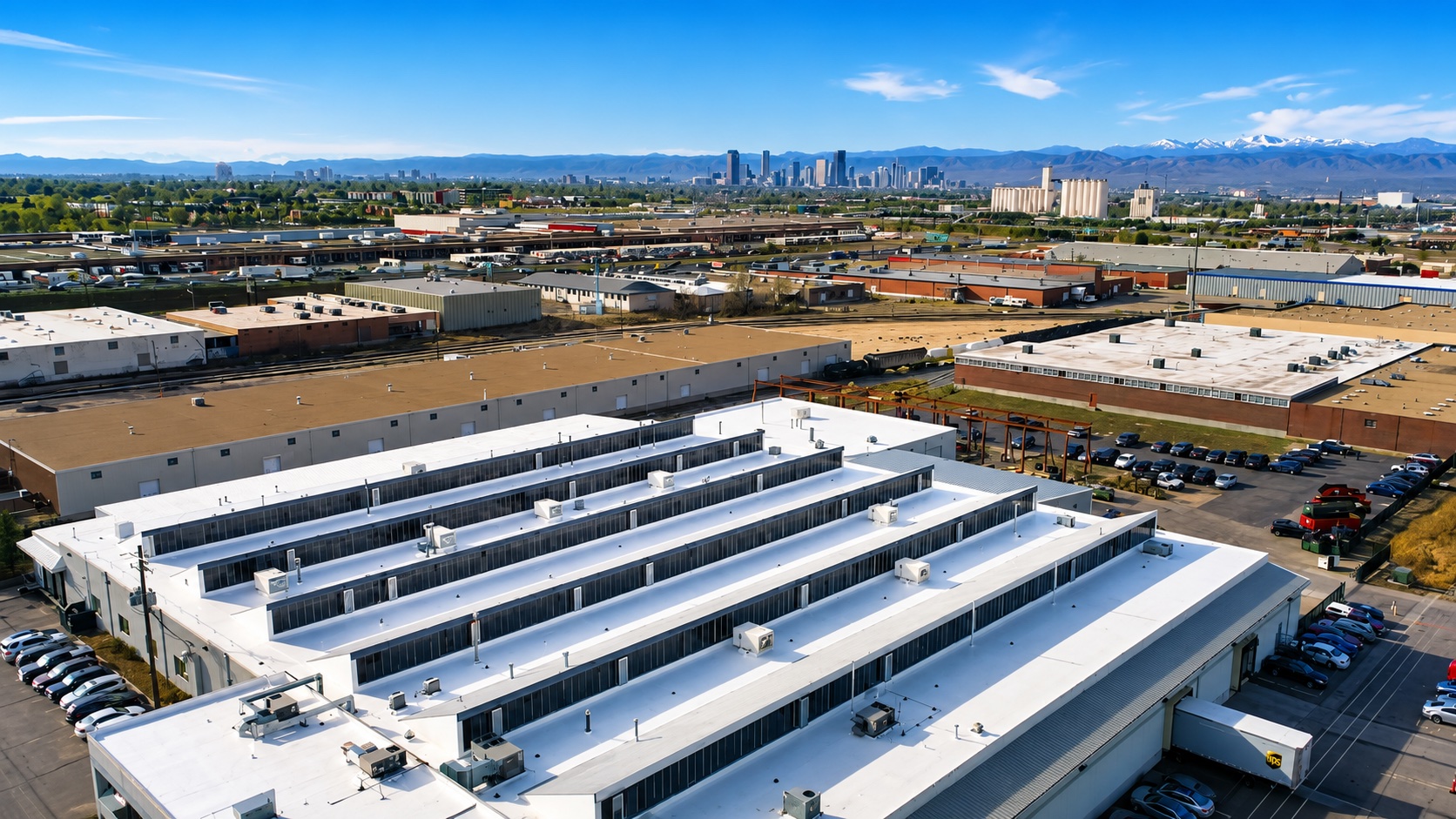
TPO’s white reflective surface earns its popularity here: it sheds Colorado’s intense sun, its heat-welded seams are stronger than glued ones, and it prices competitively — the default answer for most Front Range flat roofs. EPDM (black rubber membrane) remains a proven, economical system with decades of history, and its dark surface can be an asset on buildings where winter heat gain helps. Hail behavior, existing roof assembly, insulation goals, and rooftop equipment traffic decide it per building — both are systems we install.
How long does a commercial flat roof last?
Plan on 20–30 years for quality TPO and EPDM installations — with Colorado’s asterisk: hail usually writes the real schedule. Membrane thickness matters here more than in gentler climates (thicker mil membranes and cover boards buy real hail resilience), and so does maintenance: annual inspections, clear drains, and prompt repair of punctures around rooftop equipment are the difference between a membrane reaching its design life and a premature tear-off. We inspect and document commercial roofs on a schedule, not just after storms.
What drives commercial roof replacement cost?
Square footage sets the baseline; the multipliers are what surprises budgets: insulation requirements under current energy code (replacements typically must meet today’s R-values, not the original build’s), wet insulation discovered at tear-off, rooftop equipment that must be lifted or re-flashed, edge-metal and parapet details, and access logistics. A credible commercial quote itemizes those instead of hiding them in a lump sum — per-trade, line-item pricing is how we bid every commercial roof.
How can you tell if a flat roof has hail damage?
Flat-roof hail damage hides better than shingle damage: fractures in the membrane over insulation board edges, crushed or bruised spots that become leaks months later, split seams, and dented equipment flashings, curbs, and HVAC fins. The soft metals on the roof — vents, copings, condenser fins — document the hail intensity even where the membrane looks intact. After any significant hail event, a documented inspection with core-cut-informed judgment protects the claim window; waiting for the first interior leak can cost the association the date-of-loss argument.
Can a commercial roof be restored or coated instead of replaced?
Sometimes — and when it’s legitimate, it’s meaningful money. A structurally sound membrane or metal roof with dry insulation can take a restorative coating system that adds service years at a fraction of replacement cost. The honest gate is moisture: coating over wet insulation seals a problem in. The evaluation is straightforward — inspection plus moisture assessment — and we’ll tell you plainly which side of the line your roof is on, including when replacement is the wrong spend this year.
Commercial Storm Damage & Insurance
How is a commercial or HOA storm claim different from a homeowner claim?
Scale and structure. The policy is a commercial property or association master policy, deductibles often run as a percentage of insured values (a number worth knowing before storm season), the scope spans multiple buildings and trades, and the decision-makers are a board or owner group rather than one household. The claim mechanics reward the same things, magnified: immediate documentation, an elevation-by-elevation scope in the estimate formats carriers work in, and supplements that capture code-required items. Our commercial storm claim page covers the process end to end.
Who files the claim for a condo community — the association or the owners?
For common-element damage — roofs, siding, and building exteriors in most condo communities — the association files on its master policy, and the board or manager runs the claim. Owners’ individual policies come into play for interior damage and, through loss assessment coverage, for their share of a master-policy deductible passed through as an assessment. Getting this division right early prevents the classic post-storm mess of forty owners filing forty conflicting claims for the same siding.
What should a board know about wind/hail deductibles on association policies?
That they’ve grown &mdashh; and that the board should know the number today, not after the storm. Colorado association master policies increasingly carry percentage-based wind/hail deductibles (a share of total insured values, which on a large community is a serious figure), and that deductible typically flows to owners as a special assessment when a major claim hits. Boards that know their deductible, confirm owners carry loss assessment coverage, and keep exterior documentation current turn a chaotic storm season into an orderly claim.
Does the Wildfire Resiliency Code or building code affect commercial storm claims?
Directly. When storm repairs trigger code requirements — current energy-code insulation on a commercial reroof, or wildfire-code hardening in mapped WUI areas under the Colorado Wildfire Resiliency Code — those upgrades belong in the claim under the policy’s ordinance-and-law provisions, properly cited. The action item mirrors our homeowner advice at association scale: confirm the master policy carries adequate ordinance-and-law coverage before storm season, because code upgrades on multi-building projects are not small numbers.
How do you keep a building operating during storm restoration?
By treating operations as part of the scope: phasing that keeps entrances, docks, and parking functional, coordinating around business hours and tenant operations, protecting HVAC and rooftop equipment during roof work, and communicating schedules to tenants the way we do to residents. Restoration that closes a building costs the owner twice. “Get the claim approved, restore the property, keep operations running” is literally the order of operations on our commercial storm work.
Capital Planning & Budgets
When should an association start planning an exterior replacement project?
Two to three budget cycles before the buildings force the decision. Realistic sequence: a documented condition assessment feeding the reserve study, per-trade budget pricing the board can plan against, owner communication long before any vote, then contracting and phasing. Associations that start when siding “still looks okay” phase calmly across fiscal years; associations that start at active-leak stage get special assessments and emergency pricing. A property walk with per-trade budget numbers — free — is the honest first step, and it makes the reserve study real.
Can a large exterior project be phased across multiple years?
Yes — and for most associations it should be. Phasing by trade (roofs year one, siding year two), by building priority (worst exposure first), or by funding source (storm-scope now, capital-scope next year) all work when the pricing is per-trade and per-building from the start. The phasing disciplines that matter: lock the specification so later phases match earlier ones, and revisit pricing per phase honestly rather than pretending year-three costs in year one. We build phasing plans as part of commercial proposals, not as an afterthought.
Is winter a bad time for commercial exterior work?
Often the opposite. Siding, windows, and many roofing systems install through Colorado’s dry winter stretches, crews and permit offices are less slammed, and for occupied properties there’s a quiet advantage: patios empty, landscaping dormant, fewer residents outside. Membrane roofing has real temperature limits and some sealants have cold-weather protocols — scheduling around those is our job. For boards, the practical takeaway is that a winter start can beat waiting for the spring rush by a full season.
How do exterior materials choices affect an association’s insurance costs?
Increasingly, a lot. Class 4 impact-resistant roofing qualifies for premium credits under Colorado law (C.R.S. § 10-4-110.8) and matters more at association scale, where the roof count multiplies the discount; hail-resilient siding reduces the claim frequency that drives renewals; and in foothills communities, ignition-resistant assemblies are becoming an insurability conversation, not just a code one. Boards fighting master-policy premium increases should bring their exterior materials strategy to that fight — we can document what’s on the buildings and what an upgrade path looks like.
Working With Northern Lights Exteriors
What is a property walk, and what does the board get from it?
A no-cost, no-obligation walkthrough of the property with our commercial team: we document existing conditions by building and elevation, flag storm damage that belongs on an insurance scope versus wear that belongs in capital planning, and deliver per-trade budget numbers the board can actually plan against. It’s useful even when the project is two years out — especially then, because that’s when planning is cheap. Request a property walk or call (303) 776-5263.
Why hire one multi-trade contractor instead of separate roofing, siding, and window companies?
Because on a multi-building exterior project, the coordination is the project. One contractor sequencing trades correctly (roofing before gutters, siding coordinated with window flashing), one schedule residents and tenants can follow, one point of accountability when trades meet at a flashing detail, one insurance scope on storm work, and one warranty conversation years later. Boards that have run the four-contractor version rarely choose it twice. Roofing, siding, windows, decks, and paint under one contract is our model — it’s the company we built.
Are you licensed and insured for commercial and HOA work?
Yes — licensed in the jurisdictions we serve, carrying liability and workers’ compensation coverage, with certificates of insurance provided to the association or management company as a standard part of contracting, not on request-and-wait. We’ve served Colorado commercial, HOA, and multifamily properties since 2001; management companies and boards are welcome to speak with association references who have run full projects with us.
What warranties do associations get on commercial exterior work?
Two layers, in writing, per building: manufacturer warranties on the systems installed (registered to the association, with documentation delivered at closeout — not left for someone to chase later), and our installation warranty on the installation. For associations the paperwork matters as much as the coverage: board members and managers change, so warranty documents, product records, and closeout photos live in the project portal where the association can always retrieve them.
What property types and areas do you serve?
HOA and condo communities, townhome associations, multifamily and apartment properties, small commercial and office buildings, and mixed-use — across the Denver metro and Northern Colorado, from Denver and Boulder through Longmont, Fort Collins, and Greeley. We’ve built on the Front Range since 2001 with a 4.9 rating across 552 reviews, and our commercial services page shows recent multifamily and HOA projects.
Board Meeting Coming Up?
Bring real numbers to it. A free property walk gets your association documented conditions and per-trade budget pricing — whether the project is this year or three budget cycles out. No pressure, no obligation, since 2001.