Storm Doors · Colorado
Storm Door Installation in Colorado
A storm door is a small job with one large detail nobody mentions: what it does to the temperature of the door behind it.
Quick Answer: Should You Add a Storm Door in Colorado?
Northern Lights Exteriors installs storm doors across the Colorado Front Range. A storm door adds weather protection on an exposed entry, lets you get airflow without leaving the main door open, and takes the abrasion of wind-driven grit and snow instead of your entry door’s finish. The one thing to get right here is heat buildup: a full-glass storm door in front of a dark, sun-facing entry door can trap a great deal of heat in the space between them, and many entry door warranties address that combination directly. Check your door’s warranty before pairing the two — we will do it with you. Since 2001.
Part of our exterior door installation work — entry, patio, sliding, storm and garage doors across Colorado.
When a Storm Door Is Worth It
An exposed entry. If your front door takes wind-driven snow and afternoon sun with no cover over it, a storm door takes that abuse instead of the entry door’s finish. On a west-facing Front Range entry that is a real extension of the door’s life.
You want airflow. Colorado shoulder seasons are the argument — a retractable or full screen lets you open the house on a 68-degree April afternoon without leaving the front door standing open.
An older entry door you are not replacing yet. A storm door adds a second air barrier in front of a door with tired weatherstripping. It is a stopgap rather than a fix, but it is a cheap one that buys a season or two.
The Heat Trap: The Detail Most Quotes Skip
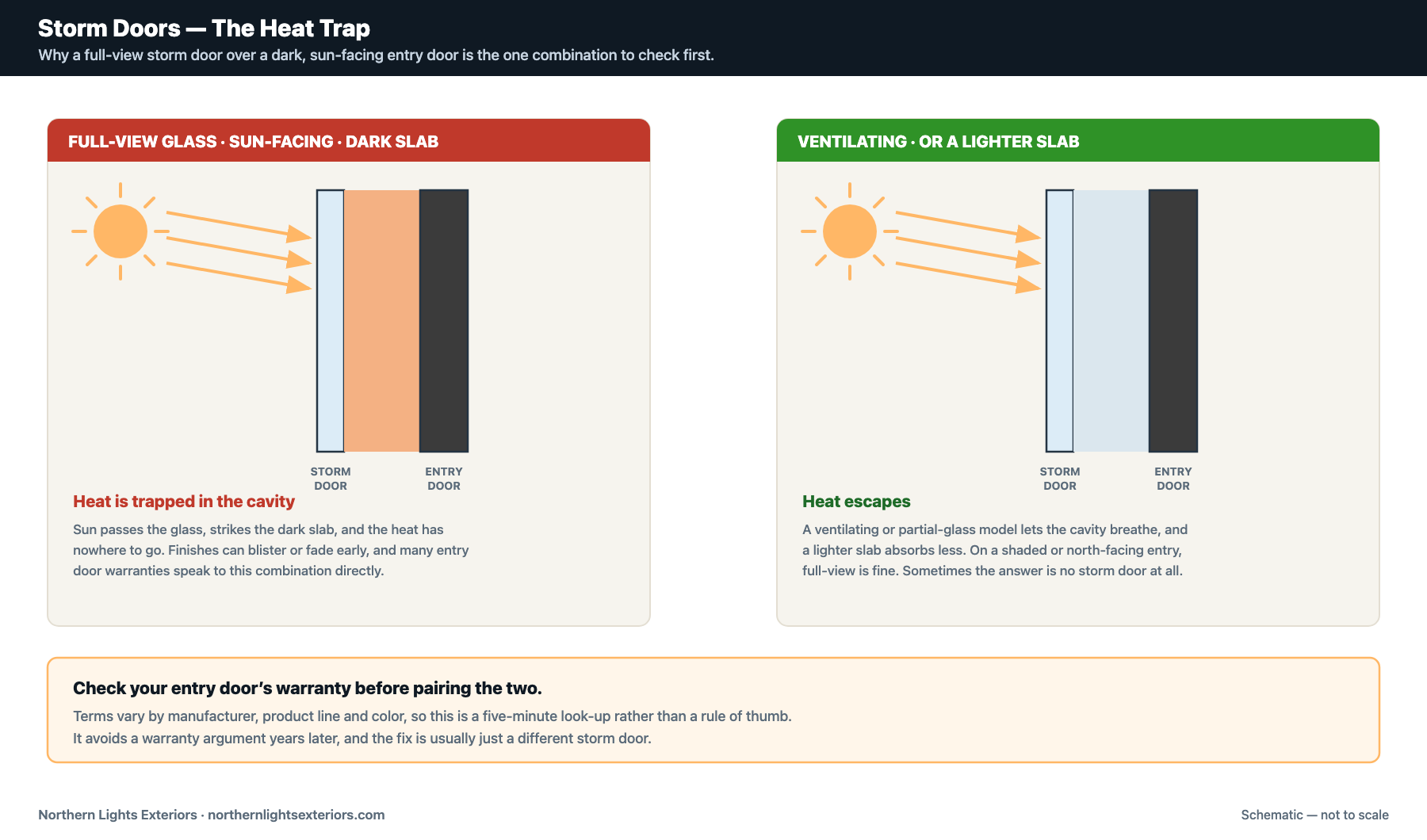
This is the part worth reading before you buy.
Put a full-view glass storm door in front of an entry door and you have built a small greenhouse. Sun passes through the storm door glass, strikes the entry door, and the heat has nowhere to go — the air gap between them can reach temperatures well above the outside air. Add a dark-colored slab and a south or west exposure and the effect compounds.
The consequences are real: finishes can blister or fade prematurely, and some door constructions do not tolerate sustained heat at that level. Many entry door manufacturers address this combination explicitly in their warranty language — sometimes limiting coverage where a full-glass storm door is installed over a dark door on a sun-facing elevation.
We are not going to tell you what your particular warranty says, because it varies by manufacturer, product line and color. What we will do is look it up with you before you buy. In practice the fix is usually simple — a ventilating or partial-glass storm door instead of a full-view one, a lighter slab color, or skipping the storm door on that particular elevation. It is a five-minute conversation that avoids a warranty argument years later.
When to Skip It
Not every entry wants a storm door, and we will say so:
If your entry is deeply covered by a porch or a portico, the storm door has little weather to protect against and mostly adds a second thing to open with your hands full.
If the entry door is new, insulated and well-sealed, a storm door adds very little thermally — the energy argument for one is much stronger in front of an old, leaky door than a current one.
If the door is dark and faces the afternoon sun, see the section above. Sometimes the honest recommendation is a ventilating model, and sometimes it is none at all.
And if the entry door itself is what is really failing, a storm door in front of it is money spent on the wrong problem. Our entry door page covers that.
Frequently Asked
Will a storm door actually lower my energy bill?
In front of an old, leaky entry door, a little — it adds a second air barrier and cuts infiltration. In front of a modern insulated door, very little; that door is already doing the work. Buy a storm door for weather protection, airflow and abrasion, and treat any energy benefit as a bonus rather than the reason.
Can a storm door damage my front door?
It can, and this is the single most overlooked thing about them. A full-view glass storm door over a dark, sun-facing entry door traps heat in the gap between the two, which can blister or fade finishes and stress some door constructions. Many entry door warranties speak to that combination directly. Check your specific door’s warranty before pairing them — we will look it up with you.
Full-view or ventilating?
Ventilating on any exposure that gets real afternoon sun, especially over a darker door, because it lets the trapped heat escape. Full-view on a shaded or north-facing entry where you mostly want the light and the view. The exposure decides this more than the look does.
Do you install storm doors on their own?
Yes. It is a small job and we will take it as one, though it is often worth doing at the same time as other exterior work if you have any planned. If the entry door behind it is the actual problem, we will tell you that before selling you a storm door.
Do you install security or screen doors as well?
Tell us what you are after and we will tell you honestly whether it is something we do. Storm doors are firmly in our scope; the further a product gets from the exterior envelope, the more likely it is that a specialist serves you better, and we would rather say so than take the job.
Thinking About a Storm Door?
Tell us which way the entry faces and what color the door is. Those two answers decide most of the recommendation, including whether we tell you not to bother.