
Colorado Hail Damage Insurance Claim Guide
From Hail Strike to Paid Claim — Updated for 2026
To file a Colorado hail damage insurance claim, photograph all exterior damage, get a licensed Colorado contractor to perform a free inspection before calling your insurer, file the claim with your storm date of loss, meet the adjuster on-site with your contractor, and review the scope of loss line by line. You generally have up to two years from the storm date to file, but most policies require prompt notification. Wind and hail claims in Colorado typically carry a separate 1–5% percentage deductible, and under Colorado Senate Bill 38 it is illegal for any roofer to pay, waive, or rebate that deductible.
Colorado sits in the heart of Hail Alley — the strip of high-elevation plains running through Colorado, Wyoming, and Nebraska that receives more large hail events than anywhere else in North America. In a typical year, the Front Range absorbs three or four catastrophic hail events between April and September, and 2024 alone produced more than $521 million in reported hail claims to a single carrier in Colorado.
That frequency is exactly why the Colorado hail claim process is different from a hail claim in most other states. The deductibles are higher, the timelines are tighter, the contractor pool is bigger (and more uneven), and there is a specific state law — Senate Bill 38 — that governs how every residential roofing contract tied to an insurance claim has to be written. This guide walks through every part of that process, in the order a homeowner will actually encounter it.
Does Homeowners Insurance Cover Hail Damage To A Roof In Colorado?
Yes — hail is a covered peril on virtually every standard Colorado homeowners policy. Hail is the most common property claim in the state, and carriers price Colorado policies around it. If a storm functionally damages your roof, a standard policy pays to repair or replace it, minus your wind & hail deductible.
Coverage normally extends beyond shingles to the whole exterior: gutters and downspouts, siding, window cladding and screens, decks, and fencing. What changes from policy to policy is how much the carrier pays and what fine print applies:
- Your wind & hail deductible — usually a separate 1–5% percentage deductible (explained below).
- ACV vs. RCV loss settlement — whether withheld depreciation is recoverable (see the comparison).
- Roof age schedules and exclusions — older roofs are increasingly forced onto ACV schedules, and metal roofs may carry a cosmetic damage exclusion.
The claim is paid on the storm’s date of loss, so the coverage that matters is the policy in force on the day of the hailstorm — not the one you hold when you file.
Why a Colorado Hail Claim Is Different
Three things make Colorado hail claims unlike claims almost anywhere else in the country:
- Percentage deductibles are now standard. Most major carriers in Colorado have moved off flat-dollar deductibles for wind and hail and onto a 1–5% percentage of dwelling coverage. On a $500,000 home, a 2% deductible is $10,000 out of pocket before the carrier contributes a dollar.
- Many policies pay the roof on ACV, not RCV. Carriers increasingly endorse a Roof Surface Payment Schedule or Actual Cash Value Loss Settlement that depreciates the roof by age — meaning a 15-year-old roof may only be paid at a fraction of replacement cost.
- Senate Bill 38 governs the contract. Any residential roofing contract over $1,000 tied to an insurance claim in Colorado must meet specific disclosure requirements, and any contractor offering to waive or absorb the deductible is asking the homeowner to participate in insurance fraud.

What To Do Right After A Hail Storm
The first 72 hours after a Colorado hail storm shape the rest of the claim. The steps below are the same ones experienced adjusters and contractors recommend.
- Document the storm date. Write down the exact date and approximate time the hail fell. Pull the NOAA Storm Events record for your ZIP code — the carrier will use it.
- Photograph everything. Roof (from the ground, never climb wet shingles), siding, gutters, downspouts, window screens, garage door, AC condenser fins, soft metal vents, deck, fencing, and any landscaping damage.
- Photograph the hail itself. Place a coin or ruler next to a representative stone before it melts. Hail size on the ground is one of the most persuasive pieces of evidence in a contested claim.
- Tarp any active leak. If water is entering the home, mitigate the damage. Save receipts — reasonable mitigation costs are reimbursable under most policies.
- Get a free inspection from a licensed local contractor before calling your insurer. Once a claim is filed with no inspection on record, the adjuster’s scope tends to anchor the entire claim.
- Do not sign anything at the door. Out-of-state crews knock neighborhoods within hours of a storm. Compare at least one established Colorado contractor before signing.
How Long Do I Have To File A Hail Claim In Colorado?
There are two deadlines that matter, and they are not the same:
| Deadline | What it means | Typical length |
|---|---|---|
| Colorado statute of limitations | The legal deadline to sue the carrier if a claim is denied or underpaid | Two years from the date of loss (C.R.S. § 13-80-102) |
| Policy notification deadline | The contractual deadline written into your policy to report the loss to the carrier | Often one year, sometimes “prompt notice” with no fixed number |
The practical takeaway: the policy deadline almost always expires before the statute does. Open the policy declarations page and search for “notice of loss” or “duties after loss” to find your contractual deadline. Then file as soon as a qualified inspection confirms damage — waiting a season can give the carrier room to argue the damage is from a later, uncovered event, or from wear and tear.
Understanding Your Wind & Hail Deductible
A wind and hail deductible is a separate deductible that only applies to wind- or hail-related claims. It is usually higher than the standard all-peril deductible, and on most Colorado policies issued since roughly 2020 it is a percentage of the dwelling coverage rather than a flat dollar amount.
How a percentage deductible works in real dollars
Northern Lights Exteriors’ 2026 examples: on $300,000 of dwelling coverage a 1%, 2% or 5% wind and hail deductible is $3,000, $6,000 or $15,000; on $500,000 it is $5,000, $10,000 or $25,000; on $750,000 it is $7,500, $15,000 or $37,500; and on $1,000,000 it is $10,000, $20,000 or $50,000.
| Dwelling coverage | 1% deductible | 2% deductible | 5% deductible |
|---|---|---|---|
| $300,000 | $3,000 | $6,000 | $15,000 |
| $500,000 | $5,000 | $10,000 | $25,000 |
| $750,000 | $7,500 | $15,000 | $37,500 |
| $1,000,000 | $10,000 | $20,000 | $50,000 |
Look for the deductible on the declarations page of your policy — not the standard all-peril deductible. A surprising number of Colorado homeowners do not realize they carry a percentage deductible until they read the claim payment summary.
ACV vs. RCV: How The Carrier Pays For Your Roof
Almost every Colorado hail payout arrives in two pieces: an Actual Cash Value (ACV) check first, then a Replacement Cost Value (RCV) check after the work is finished. Knowing which version of “Loss Settlement — Roof Surface” appears on your declarations page determines whether the second check actually arrives.
We break this down step by step — a worked dollar example, recoverable vs. non-recoverable depreciation, and the deadline that governs your second check — in our companion guide: RCV vs ACV on a Colorado roof claim.
| Replacement Cost Value (RCV) | Actual Cash Value (ACV) | |
|---|---|---|
| First check | Replacement cost minus depreciation minus deductible | Replacement cost minus depreciation minus deductible |
| Second check | Recoverable depreciation released after final invoice | None. Depreciation is permanently withheld. |
| Homeowner pays | Deductible only (assuming scope is complete) | Deductible + all depreciation |
| Best for | Roofs under ~10–15 years | (Rarely best — usually a forced endorsement on older roofs) |
If the policy lists a “Roof Surface Payment Schedule,” “Roof Settlement Endorsement,” or “ACV Loss Settlement — Roof Surface,” the roof is paid on ACV. The older the roof, the larger the depreciation. This is one of the biggest reasons two neighbors hit by the same storm can receive completely different checks.
Will Insurance Pay For Hail Damage To A Metal Roof?
Usually yes — but metal roofs are where Colorado hail claims most often get complicated. If hail causes functional damage to a metal roof — punctured or split panels, crushed seams or ribs, broken fasteners, or coating fractures that expose bare steel to rust — a standard policy covers replacement the same way it covers a shingle roof. The friction point is dent-only damage.
Many carriers have added a cosmetic damage exclusion to Colorado policies with metal roofs. Under that endorsement, dents that change how the roof looks but not how it performs can be denied entirely. Whether a dent is “cosmetic” or “functional” is a judgment call made in the adjuster’s report — which is exactly why inspection and documentation matter more on metal than on any other roofing material.
Three things to do before filing a metal roof hail claim:
- Read your declarations page first. Look for a cosmetic damage exclusion or “metal roof surfaces” endorsement. If it is not on the policy, dent damage is generally adjustable like any other hail loss.
- Document the soft metals. Dented gutters, downspouts, roof vents, flashing, and A/C fins prove hail intensity on-site and are covered items in their own right, even where a panel dent is disputed.
- Have a metal roofing contractor classify the damage in writing. Impact fractures vs. oil-canning, coating damage vs. surface scuffing, and seam integrity on standing seam systems — where one damaged panel can force replacement of an interlocked run — are technical calls a general adjuster can miss.
Northern Lights Exteriors installs and inspects standing seam and steel roofing systems across the Front Range and documents metal hail claims with panel-level photo evidence, so the functional damage on the roof is what ends up in the adjuster’s file.
Storm Damage Beyond the Roof — Siding, Windows, Gutters & Decks
Colorado hail almost never stops at the shingles. The same storm that bruises a roof cracks siding on the impact-facing walls, shreds window screens, dents gutters and vents, and chews up paint and garage doors — yet many claims get scoped roof-only because a roofing-only contractor inspected. One storm should mean one claim with the whole exterior in the scope, documented in one inspection. That is the practical advantage of a multi-trade contractor: we scope roof, siding, windows, gutters, and decks together, so nothing gets left for a second fight later.
Siding in a hail claim
Hail damage to siding shows up as cracked or shattered vinyl, dented aluminum and steel, and chipped or fractured fiber cement — concentrated on the west- and north-facing walls the storm drove against. Siding claims come with a twist roofs rarely have: the product on your walls may be discontinued, which raises the matching question covered below. Document every elevation, not just the worst one, and photograph damage before any cleanup.
Windows and glass in a hail claim
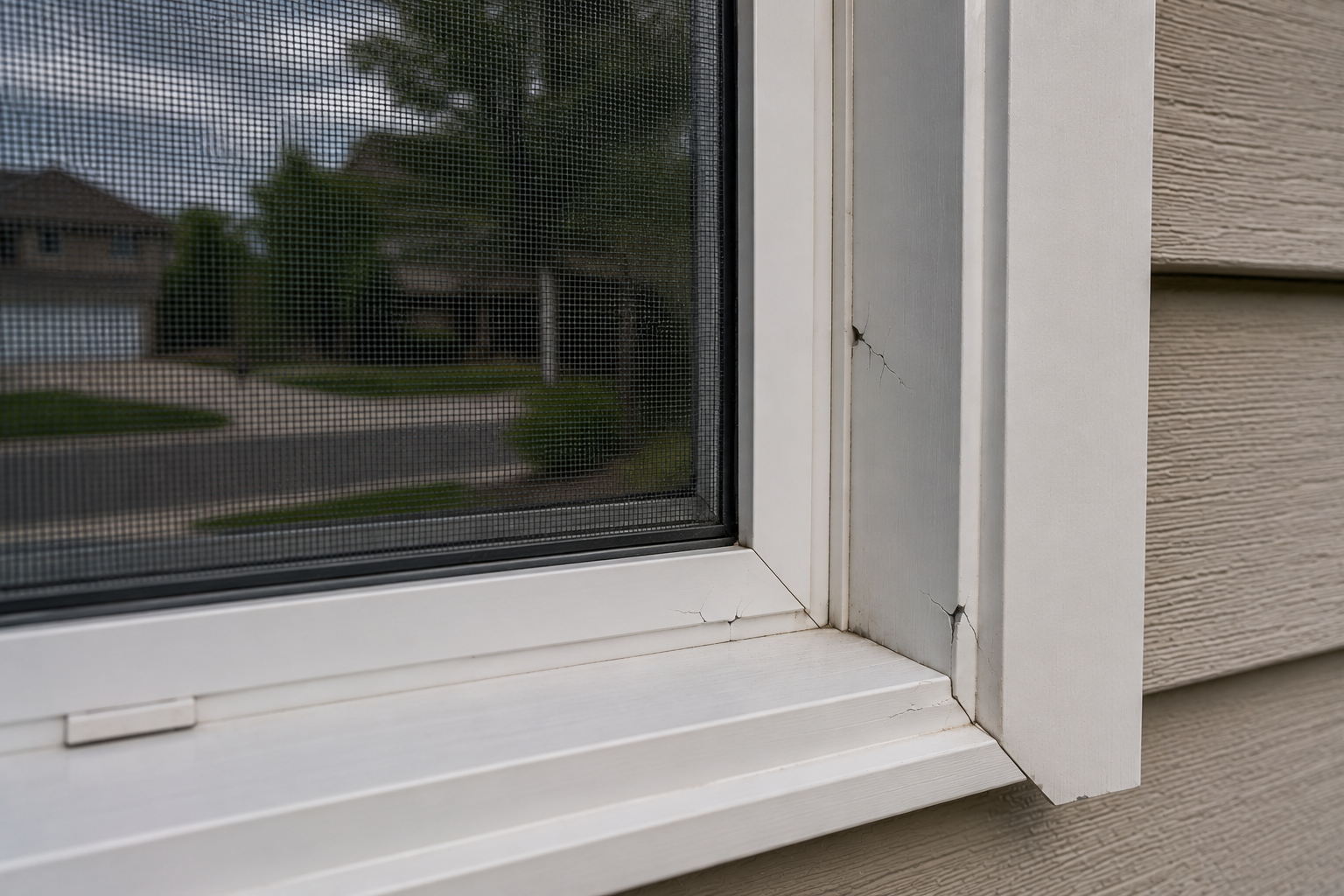
Broken panes are the obvious part. The claim-relevant damage most inspections miss: shredded screens (covered items in their own right), cracked frames and nailing fins, dented aluminum cladding — and impact-fractured seal spacers on insulated glass units, a failure that shows up as fog between the panes months after the storm, long after the date of loss matters. That delayed-fog pattern is why we photograph window elevations during every hail inspection, even when the glass looks intact.
Gutters, soft metals, and the small covered items
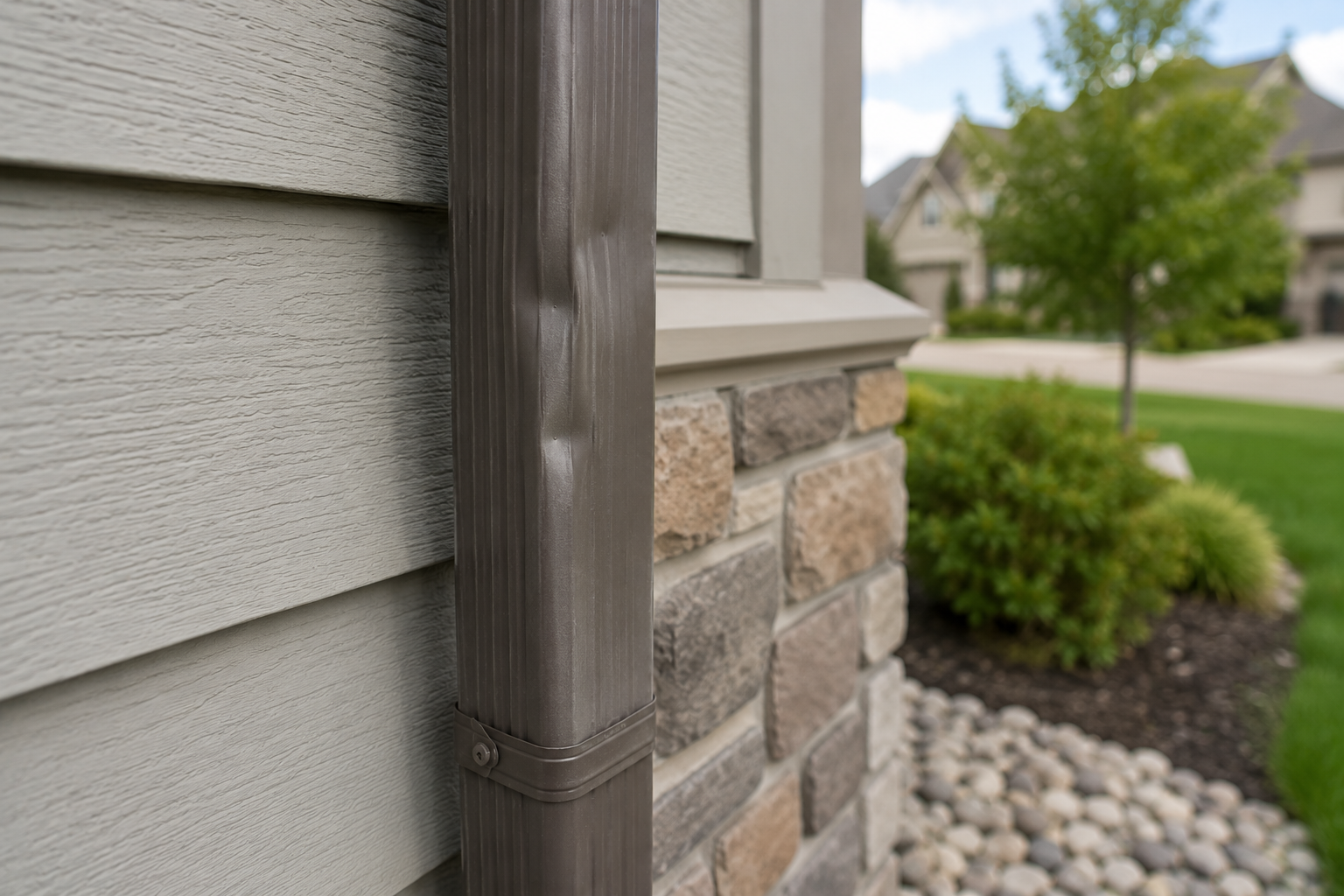
Gutters, downspouts, roof vents, flashing, and A/C fins are the first place hail shows — soft metals dent at hail sizes that leave shingles arguable — and they do double duty in a claim: they are covered damage themselves, and they are the on-site evidence that establishes hail intensity when a carrier questions the roof. A scope that includes the roof but skips dented gutters is leaving both money and proof on the table.
Decks, paint, and everything else outside
Composite deck boards take hail well, but deck railings, painted surfaces, light fixtures, window wells, and garage doors frequently belong in the same scope. The rule of thumb: walk the entire property within days of the storm and photograph anything that changed. Carriers pay documented damage; they cannot pay what nobody scoped.
Wind damage vs. hail damage
Colorado’s storms deliver both, and they leave different fingerprints: wind creases and lifts shingles at the tab line, peels siding panels from their locks, and takes fences and trim — while hail bruises and fractures surfaces on impact-facing planes. Both typically fall under the same wind/hail deductible on Colorado policies (check your declarations page), but the inspection evidence differs, and a scope written for the wrong peril invites dispute. We document which peril caused what, elevation by elevation.
Does Colorado require insurance to match my siding or shingles?
There is no Colorado matching statute or insurance regulation — but that is not the whole answer. Colorado courts have sided with homeowners where the policy promises repairs of “comparable material and quality,” and matching disputes (especially over discontinued siding) remain actively litigated. Carriers have responded by adding explicit matching exclusions to some policies. Practically: the outcome turns on your policy language, so read it before the storm, and expect the matching conversation on any claim involving discontinued products — it is one of the strongest reasons to have an experienced contractor documenting line-of-sight and product-availability arguments in the scope.
The Step-By-Step Colorado Hail Claim Process
From inspection to final depreciation check, a typical Colorado hail claim runs about 30 to 90 days. Here is the sequence in the order it actually happens:
- Free contractor inspection. A licensed Colorado contractor performs a full exterior inspection — roof, gutters, siding, windows, screens, soft metals, AC condenser. They produce a damage report and photos.
- Decision to file. If damage exceeds the wind/hail deductible, the homeowner files the claim. If it does not, no claim is filed and no claim history is created.
- Open the claim. Call the carrier or use the app. Provide the date of loss, address, and a brief description. Write down the claim number and the adjuster’s name and direct line.
- Adjuster inspection. The carrier assigns a field adjuster, who schedules an on-site inspection. The contractor should be present.
- Scope of loss issued. The adjuster writes the scope of loss in Xactimate (the industry-standard estimating software) and the carrier issues an ACV check minus the deductible.
- Scope review. The contractor reviews the scope line by line for missing items, incorrect quantities, missing code upgrades, and outdated pricing. Most initial scopes need at least one revision.
- Supplement filed (if needed). Missing or incorrect line items are submitted to the carrier with photos and documentation. The adjuster approves or denies each one.
- Mortgage company endorsement. If the home has a mortgage, the lender’s name appears on the claim check. The homeowner endorses the check and forwards it to the mortgage servicer, who releases funds in stages.
- Work performed. Material is delivered, permits are pulled, and the work is completed to local code.
- Final invoice & depreciation release. The final invoice is submitted to the carrier. If the policy is RCV, the recoverable depreciation is released as a second check. The deductible has now been satisfied through the homeowner’s deductible payment plus the contractor’s invoiced cost.
The Adjuster Meeting — What To Expect
The on-site adjuster inspection is the single most important step in the entire claim. A well-prepared inspection is the difference between a complete payout and a stripped-down scope that misses items the homeowner has to pay for later.
Before the adjuster arrives
- Have the contractor’s damage report and photo set ready — printed or on a tablet.
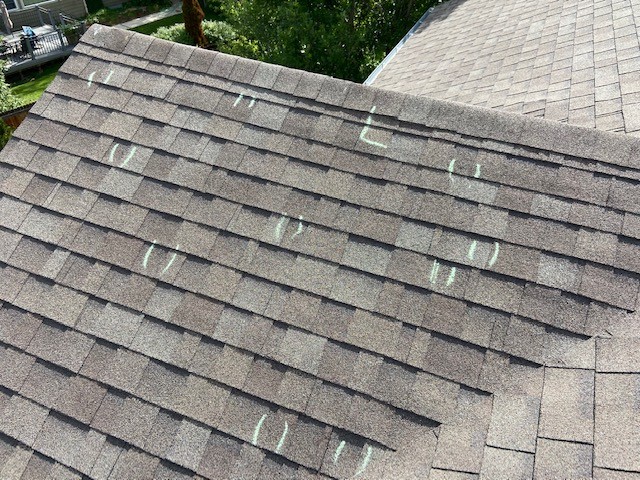
- Mark hail hits on the roof with chalk circles so the adjuster does not have to find each one.
- Have a ladder up and ready (the contractor brings their own).
- Know your storm date and have the NOAA hail report bookmarked.
During the inspection
- The contractor should walk the roof with the adjuster, not behind them.
- Test squares (10×10 ft sections) are typically measured on the four most-exposed slopes.
- The homeowner does not need to be on the roof — but should be on-site, available to discuss interior damage, water intrusion, and any prior repairs.
- Take notes on which items the adjuster acknowledges and which they push back on.
After the inspection
- Request a copy of the full scope of loss in PDF or Xactimate ESX format.
- Request the adjuster’s photo report.
- Expect the first check within 7–14 business days.
Recoverable Depreciation, Explained
Depreciation is the dollar amount the carrier subtracts from the replacement cost to reflect the age and wear of the damaged item. On a Replacement Cost Value (RCV) policy, that depreciation is recoverable — it is held back from the first check, but released after the work is done and invoiced. On an Actual Cash Value (ACV) policy, depreciation is permanently withheld.
A simple example on a $24,000 roof with $6,000 depreciation and a $5,000 deductible:
- RCV check #1: $24,000 − $6,000 depreciation − $5,000 deductible = $13,000
- Work performed and invoiced at the full $24,000.
- RCV check #2 (depreciation release): $6,000
- Homeowner out of pocket: $5,000 deductible
Most policies require the depreciation to be claimed within 180 days of the first payment. Miss that window and the recoverable depreciation can be forfeited. Every window on the claim — from the three-business-day cooling-off right on door-signed contracts to the two-year statute of limitations — is mapped on one timeline in our Colorado hail claim deadlines guide.
Supplements & Code Upgrade Coverage
It is rare for a first scope of loss to capture everything needed to fully restore the property. We cover the whole process — underscoped line items, permits billed at actual cost, tear-off discoveries, and the window and door pricing gap — in our guide to how roof claim supplements work in Colorado. Common missing items include:
- Drip edge (now required by Colorado roofing code in most municipalities)
- Ice and water shield in valleys and at eaves
- Synthetic underlayment versus felt
- Ridge ventilation versus static vents
- Step flashing replacement (not just reuse)
- Detached structures — sheds, fences, detached garages
- Soft metals — gutters, downspouts, vents, caps
- Window screens, garage door, AC condenser combing
- Painted items damaged by hail (and the matching paint requirement)
Each of these can be submitted as a supplement with photos, code citations, and an Xactimate line-item description. A contractor who handles supplements as a normal part of the process typically recovers 10–30% in additional scope on a Colorado hail claim. Code upgrade coverage (often listed as “Ordinance or Law” or “Coverage D—Building Code”) is a separate sublimit and is almost always under-used. In mapped WUI areas — Colorado’s foothills and mountain communities, not most plains homes — it is about to matter far more: the state’s 2025 wildfire resiliency code means a storm-damaged roof or siding there may not be allowed back like-for-like, and the gap between the like-kind payment and the Class A fire-rated, ignition-resistant assembly the code requires falls on the homeowner unless code upgrade coverage is in place. Two questions for your agent before the next storm: do I have Ordinance & Law coverage, and is the sublimit realistic? Our Colorado Wildfire Resiliency Code guide explains what the code requires — not every jurisdiction asks for the same things, so we confirm the requirements for your specific address before any scope is written.
Colorado Senate Bill 38 — The Contractor Rules Every Homeowner Should Know
Colorado Senate Bill 38, signed into law in 2012 and codified at C.R.S. §§ 6-22-101 through 6-22-105, is the state’s residential roofing consumer protection statute. It applies to every residential roofing contract over $1,000 tied to a property insurance claim. The most important provisions for homeowners:
- A written contract is required with the scope of work, materials, cost, approximate dates, contractor contact information, and surety/liability insurer information.
- Three-day right of rescission. The homeowner can cancel the contract within 72 hours of being notified that the insurer has denied the claim in whole or in part.
- No payment to the contractor before delivery. The contractor must hold any payment in trust until materials are delivered or the majority of the work is performed.
- No deductible waiver. It is illegal for a roofing contractor to pay, waive, rebate, or credit the homeowner’s insurance deductible. Any offer to do so is a request to commit insurance fraud.
- No acting as a public adjuster. A roofing contractor cannot negotiate the claim on behalf of the homeowner unless they are also a licensed Colorado public adjuster.
How To Spot & Avoid Storm Chasers
Within 48 hours of any major Colorado hail event, out-of-state crews flood Front Range neighborhoods. Some are legitimate. Many are not. The pattern is so consistent that the Colorado Roofing Association maintains a public warning page about it. Common red flags:
- Door-knocking the day of or day after a storm with paperwork already filled out
- Out-of-state phone number, out-of-state license plate, no local office
- “We’ll cover your deductible” — illegal under SB 38
- “Free roof — no out-of-pocket” — same problem
- Pressure to sign a “contingency agreement” or “authorization to inspect” before any damage is confirmed
- Vague or missing surety/liability insurance information
- No reviews older than the most recent storm season
- Asks for the insurance check to be signed over directly to the contractor
A legitimate Colorado contractor will be happy to provide a license number, a local physical address, a certificate of insurance from a Colorado-admitted carrier, references from prior storm seasons, and an SB 38-compliant contract before asking for any commitment.
For the full pattern — including why storm crews only want the roof and leave the slower trades stranded — see our guide to storm-chaser red flags in Colorado: eight tells you can read in one doorstep conversation.
What To Do If Your Colorado Hail Claim Is Denied Or Underpaid
A denied or partially denied hail claim is not the end of the road. Colorado law and standard policy language both give the homeowner several escalation paths.
- Get the denial in writing. Request the specific policy language the carrier is relying on, plus the full adjuster report and photo set.
- Get a second inspection. A licensed contractor or independent inspector documents the damage with a written report.
- Reopen / supplement. Many “denials” are really partial denials and can be resolved by supplementing missing scope.
- Invoke the appraisal clause. Most policies include an appraisal provision: each side picks an appraiser, the two appraisers pick a neutral umpire, and any two of the three set the binding amount of loss.
- File a complaint with the Colorado Division of Insurance. The DOI accepts homeowner complaints online and will request a written response from the carrier.
- Consult a Colorado bad faith attorney. Under C.R.S. § 10-3-1115 and § 10-3-1116, a carrier that unreasonably delays or denies a covered claim can be liable for two times the covered benefit plus attorney fees.
10 Common Mistakes Colorado Homeowners Make On Hail Claims
- Calling the carrier before any contractor has inspected the roof
- Signing with the first door-knocker because the offer felt urgent
- Believing “we’ll cover your deductible” is legal in Colorado (it is not)
- Not photographing the hail with a ruler or coin before it melted
- Missing the policy’s internal notice-of-loss deadline (often shorter than the 2-year statute)
- Forgetting to claim soft metals, screens, AC, and detached structures
- Not reading the “Roof Surface” loss settlement endorsement on the declarations page
- Letting the recoverable depreciation 180-day window expire
- Endorsing the carrier check directly over to a contractor before work is done
- Not getting a written, SB 38-compliant contract before any work begins
Frequently Asked Questions
How long do I have to file a hail damage insurance claim in Colorado?
Colorado’s general statute of limitations for property damage is two years from the date of the storm. However, most homeowners insurance policies require prompt notification and may have their own internal deadline — sometimes as short as one year from the date of loss. File as soon as a professional inspection confirms damage.
What is a wind and hail deductible in Colorado?
A wind and hail deductible is a separate, higher deductible that applies only to wind or hail claims. In Colorado, most carriers now use a percentage-based deductible of 1% to 5% of the dwelling coverage. On a home insured for $500,000 with a 2% deductible, the homeowner pays $10,000 before insurance contributes.
Can a roofing contractor pay or waive my hail damage deductible?
No. Under Colorado Senate Bill 38 (C.R.S. §§ 6-22-101 through 6-22-105), it is illegal for a residential roofing contractor to pay, waive, rebate, or credit a homeowner’s insurance deductible. Any contractor offering to do so is asking the homeowner to commit insurance fraud.
What is the difference between ACV and RCV on a hail claim?
ACV (Actual Cash Value) is the depreciated value of the damaged roof, paid first. RCV (Replacement Cost Value) is the full cost to replace the roof with new materials. With an RCV policy, the depreciation withheld from the first check is released as a second payment after the work is completed and invoiced.
Will filing a hail damage claim raise my insurance premium?
A single hail claim usually does not cause a large individual premium increase, especially in Colorado where hail claims are routine. However, repeated claims in a short window, statewide rate revisions, and non-renewal exposure are all real factors. Document the storm date carefully so the claim is filed under the correct loss event.
What should I do if my hail damage claim is denied?
Request the denial in writing, request the adjuster’s full report and photos, and have a licensed contractor or a public adjuster perform an independent inspection. Most policies also include an appraisal clause that allows a binding independent appraisal. If the carrier acted unreasonably, Colorado law (C.R.S. § 10-3-1115/1116) allows a bad faith claim that may recover double damages and attorney fees.
Do I need three estimates for a hail damage claim in Colorado?
No. Colorado homeowners are not required to collect multiple estimates. The carrier writes the scope of loss using its own estimating software (typically Xactimate), and a single qualified contractor can review and supplement that scope.
How big does hail need to be to damage a Colorado roof?
Hail roughly the size of a quarter — about 1 inch in diameter — is the common threshold for damaging an asphalt shingle roof, but wind speed, roof age, shingle brand, and impact angle all matter. Older roofs and 3-tab shingles can show damage from smaller stones.
Does hail damage only affect the roof?
No. Severe Colorado hail events routinely damage siding, gutters, downspouts, window screens, garage doors, AC condenser fins, soft metal vents, exterior paint, and detached structures like sheds and fences. Every component should be inspected before the claim is filed.
Who pays the deductible — me or the contractor?
The homeowner pays the deductible. Under Colorado Senate Bill 38, the contractor may not pay, waive, rebate, or credit it in any form.
Can I file a hail claim from a storm last year?
Often, yes — as long as the date of loss falls within both the policy’s notice deadline and Colorado’s two-year statute of limitations. The carrier may require a NOAA storm report and a contractor inspection report to confirm the date of loss.
What if my mortgage company is on the insurance check?
If the home has a mortgage, the lender is a named loss payee. The homeowner endorses the check and forwards it to the mortgage servicer, which releases funds in stages as the work is completed and inspected.
Need a Colorado Hail Damage Inspection?
If your home was in the path of a recent Front Range storm, a free professional inspection is the right first step — before calling the carrier. Northern Lights Exteriors has been working with Colorado homeowners and insurance carriers on hail claims since 2001.
Request a Free Hail Inspection
Or call 303-776-5263
How can I tell if my roof has hail damage?
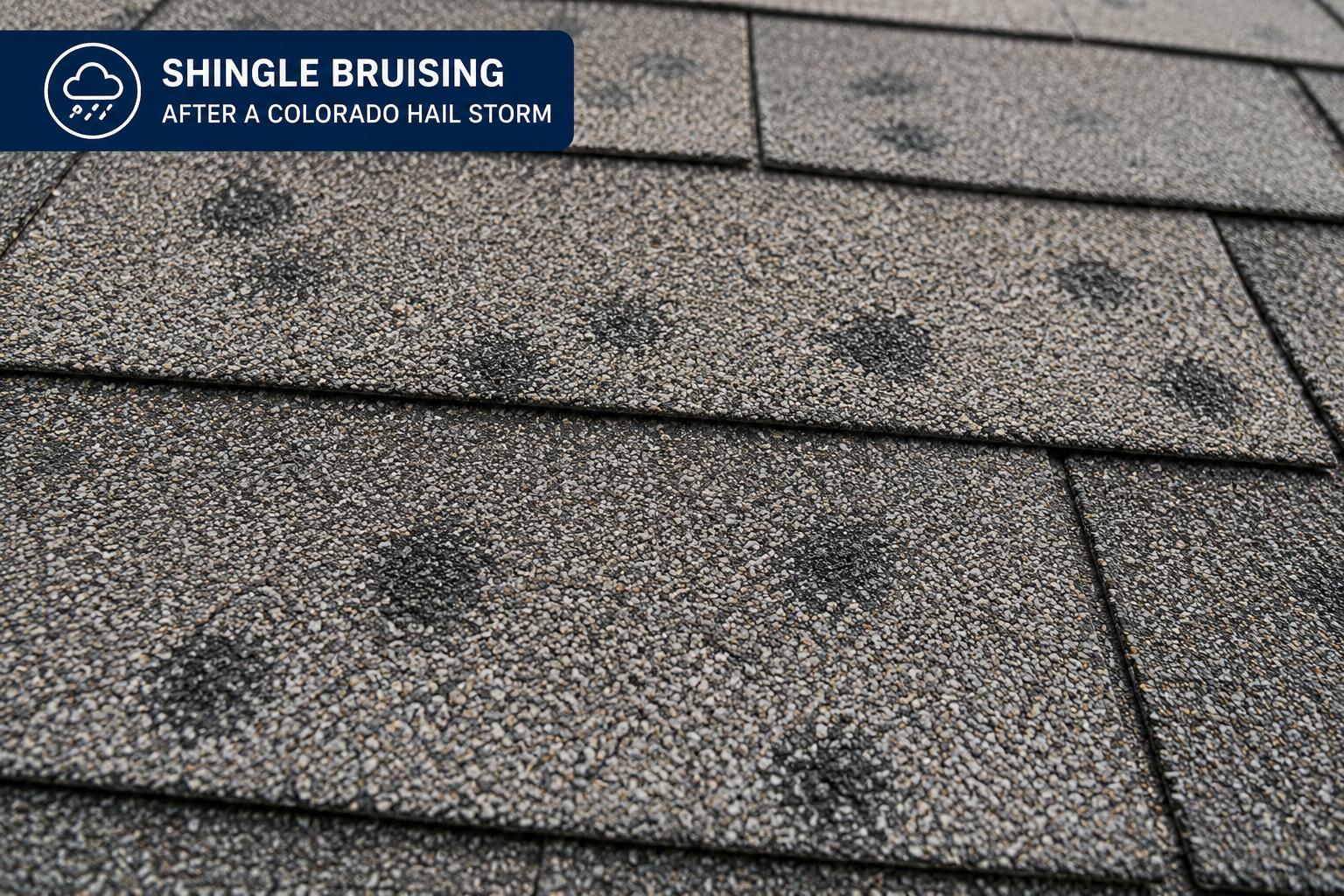
From the ground, look for dented gutters, downspouts, and roof vents, bruised or missing shingle granules collecting in gutters and splash blocks, and dark “bruise” spots on shingles. Soft-metal dents are the most reliable ground-level indicator that hail was large enough to damage the roof itself. Actual confirmation requires walking the roof — adjusters look for granule loss exposing the mat, circular bruises that feel soft, and cracked or fractured shingles — so get a professional inspection before filing.
Does homeowners insurance cover hail-damaged siding and windows?
Yes — siding, windows, screens, gutters, and other exterior elements are part of the same dwelling coverage that pays for the roof, under the same wind/hail deductible. Colorado hail rarely damages the roof alone, so the whole exterior belongs in one claim scope, documented in one inspection.
Does Colorado law require my insurer to match undamaged siding or shingles?
No statute requires it — but Colorado courts have supported matching where policies promise repairs of “comparable material and quality,” and some policies now carry explicit matching exclusions. The outcome depends on your policy language, which makes documentation of discontinued products and line-of-sight arguments critical in the claim scope.
Is wind damage covered the same way as hail damage?
Generally yes — wind and hail typically share the same peril coverage and the same separate wind/hail deductible on Colorado policies. The damage evidence differs (creased and lifted shingles versus impact bruising), so the inspection should identify which peril caused what before the claim is filed.
Does homeowners insurance cover hail damage to a roof in Colorado?
Yes. Hail is a covered peril on standard Colorado homeowners policies and is the most common property claim in the state. Payment is subject to a separate wind and hail deductible — typically 1–5% of dwelling coverage — and to whether the policy pays replacement cost (RCV) or depreciated value (ACV).
Will insurance pay for hail damage to a metal roof?
Yes, when the damage is functional — punctured panels, damaged seams or fasteners, or fractured coatings. Dent-only damage can be denied if the policy carries a cosmetic damage exclusion. Check the declarations page for that endorsement and have a metal roofing contractor classify the damage in writing before filing.
What is a cosmetic damage exclusion?
An endorsement many carriers add to policies — most often on metal roofs — that removes coverage for hail damage affecting only appearance, such as dents that do not compromise the roof’s ability to shed water. Functional damage remains covered even when the endorsement is present.
Sources & Further Reading
- Colorado Division of Insurance — After a Hail Storm Insurance FAQs (doi.colorado.gov)
- Colorado Revised Statutes §§ 6-22-101 through 6-22-105 (Senate Bill 38 — Residential Roofing Consumer Protection)
- Colorado Revised Statutes §§ 10-3-1115 and 10-3-1116 (Unreasonable delay or denial of claims — bad faith)
- Colorado Revised Statutes § 13-80-102 (Two-year statute of limitations — tort and property damage)
- Colorado Roofing Association — Waiving Insurance Deductibles is Illegal in Colorado
- National Oceanic and Atmospheric Administration (NOAA) — Storm Events Database
- Rocky Mountain Insurance Association — Hail loss data, Colorado Front Range
- State Farm 2024 hail damage report — Colorado totaled $521 million in reported claims