
Storm-Chaser Roofers in Colorado: 8 Red Flags Before You Sign Anything
Homeowner Decision Guide · Roofing · Storm Damage
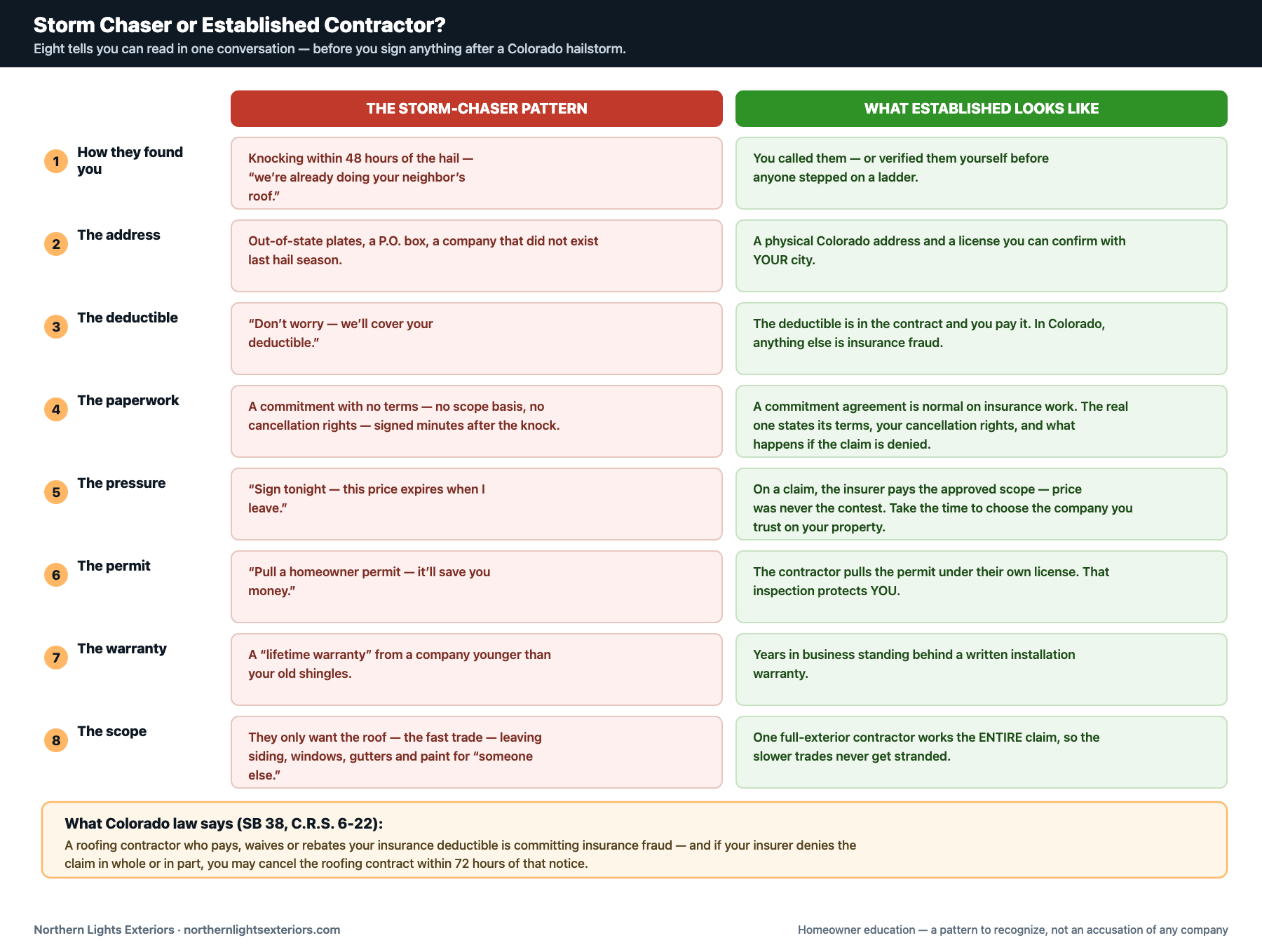
8 Tells That Separate Storm Chasers From Established Colorado Roofers
Within 48 hours of a hailstorm, crews you have never heard of are on your street. Some are legitimate. This guide shows you the business model to watch for — eight tells you can read in one conversation, what Colorado law actually protects, and what to do if you already signed something at the door.
A storm chaser is a contractor whose business model is the storm, not the roof: arrive fast after hail, sign as many insurance jobs as possible at the door, subcontract the installs at volume, and move on before the installation warranty means anything. The tell is never the accent or the license plate — it is the paperwork. The eight comparisons below can be read in a single doorstep conversation, and Colorado law backs you on two of them.
What a Storm Chaser Is — and Isn’t
After a hail event, roofing demand in a Colorado zip code can jump from a trickle to hundreds of claims in a week. That surge attracts two kinds of companies: established contractors adding crews to serve their own backyard, and operations built specifically to harvest the surge — lead crews who sign contracts at the door, installs subcontracted at volume, and a corporate address that moves with the weather.
Be fair about what this is not. Knocking on doors after a storm is legal and plenty of legitimate local companies do it. Out-of-state plates on a crew truck prove nothing by themselves — established contractors hire traveling installers in surge years too. The storm-chaser pattern is not about where anyone is from. It is a paperwork pattern: who signs you, what you sign, when they want it signed, and who is left holding the warranty when the season ends. That is why every tell below is something you can verify, not something you have to feel out.
One more reason this matters beyond the install itself: your roof is an insurance asset. A claim handled badly — scope signed away at the door, deductible games, work done without a permit — follows the house, not the contractor.
The Eight Tells, Explained
1. How they found you. “We’re already doing your neighbor’s roof” is the oldest line in the trade — sometimes true, always unverifiable in the moment. The direction of the relationship is the tell: a contractor you found, called and checked starts the job accountable to you. One who found you within 48 hours of the hail starts the job accountable to a quota.
2. The address. Ask where the company’s office is — the physical one, not the P.O. box — and how long it has been there. Then check the license with your city, because Colorado has no statewide roofing license; licensing happens city by city. A company that did not exist last hail season will not exist for a warranty claim three winters from now.
3. The deductible. “We’ll cover your deductible” is the cleanest single filter in this list, because under Colorado’s SB 38 a roofing contractor who pays, waives or rebates an insurance deductible is committing insurance fraud — with your name on the claim. A contractor willing to open the relationship with fraud is telling you how the rest of the paperwork will go.
4. The paperwork. Here is the nuance most red-flag lists get wrong: a commitment agreement is a normal part of legitimate insurance work. Before a single shingle is ordered, the contractor representing your claim does real work — meeting the adjuster on the roof, documenting the damage, rewriting the scope for missed items, pricing and code requirements. No company can do that advocacy on a handshake, so asking for a commitment before that work starts is fair; established contractors, ours included, ask for one. The red flag is a commitment without terms: a doorstep form signed minutes after the knock, from a company you have not verified, with no scope basis, no statement of what happens if the claim is denied, and no cancellation rights spelled out. The legitimate version ties the work to the insurance-approved scope and states your cancellation rights in writing, as Colorado law requires — and it comes after you have checked the company out, not before.
5. The pressure. “This price expires when I leave” is hollow everywhere, but on an insurance claim it is hollow twice over — because the price was never the variable. Your insurer pays the scope it approves, not the lowest of three doorstep numbers; collecting competing estimates on a claim mostly benefits the insurance company. What actually changes your outcome is which contractor reviews the insurer’s scope and rewrites it for what is missing — items, pricing, code requirements. So the rush is not protecting a price. It is preventing the one decision that matters: choosing, deliberately, the company you want on your property — one with a long-standing presence in your market and the claim experience to make sure nothing gets missed. Our guide to what a roofing estimate should include shows what a complete scope names in writing.
6. The permit. If anyone suggests a homeowner permit “to save money,” decline. The permit, pulled by the contractor under their own license, is the only point in the project where someone who does not work for them inspects the work — and a homeowner permit quietly moves the liability for the job onto you.
7. The warranty. A “lifetime warranty” is a sentence; a company still answering its phone in ten years is a fact. Judge the promise by the years in business behind it, and get the installation warranty in writing with a number on it.
8. The scope. Listen for what they do not bid. Hail rarely hits only shingles — the same storm that opened your claim usually damaged siding, window wraps, gutters, paint, screens — but the doorstep pitch is about one thing: the roof, this second. That is not an accident, and the next section explains why.
The Cherry-Pick: Why Storm Chasers Only Want Your Roof
A roof is the fastest component of a storm claim to complete: one trade, one crew, often one or two days, and the cleanest line on the insurance scope. Everything else the storm touched — siding, windows, gutters, paint, even solar panels — typically takes rounds of back-and-forth with the insurance company: supplements, matching questions, code items, trades that have to be sequenced. Fast trade, fast payout; slow trades, slow payout. A volume business built on the storm takes the first and leaves the second.
Here is what that means for you six weeks later: the “easy” part of your claim is done, the roofer is three zip codes away, and you are holding the smaller, more complicated trades — the ones many companies will not even book an appointment for. Now you are finding a siding contractor, a window contractor and a painter separately, re-explaining the claim to each one, with nobody responsible for the whole scope.
The alternative is structural, not heroic: a full-exterior contractor working the entire claim as one project. One company scopes everything the storm touched, pushes the insurer on every missing item — not just the roof line — sequences the trades in the right order, and answers for the whole job with one warranty and one project manager. The claim gets written the way it should be, and the project runs the way the single-trade version never does.
So treat roof-only urgency as what it is. Door-knocking is engineered to get your roof done this second — but unless the roof is actively leaking (and if it is, emergency mitigation is its own small, insurer-covered step — it does not require signing the whole claim away), the clock is on your side. Take the time to vet, and choose a full-exterior contractor to work the entire claim.
What Colorado Law Actually Protects
Colorado’s residential roofing consumer-protection statute — Senate Bill 38, C.R.S. 6-22-101 through 6-22-105 — was written for exactly this moment, after exactly these storms. Three protections do most of the work:
The deductible rule. A roofing contractor may not pay, waive, rebate or promise to rebate any part of your insurance deductible. Any offer to do so is insurance fraud under Colorado law.
The 72-hour rule. If your insurer denies the claim in whole or in part, you may cancel the roofing contract within 72 hours of being notified of that denial — which is precisely the escape hatch for a contingency agreement signed at the door before the adjuster ever saw the roof.
The written-contract rule. Roofing contracts in Colorado must be in writing and must state the scope, the price and the contractor’s contact information — a doorstep form with a signature line and no scope does not meet the standard a legitimate contractor works to.
These are consumer-protection facts, not legal advice for your specific contract — for a dispute, your insurer and the Colorado Division of Insurance are the right first calls. For how the whole claim should run from first inspection to final invoice, our Colorado hail damage insurance claim guide walks the full sequence.
The 20-Minute Answer: Verify Instead of Guessing
Every tell above has a verification behind it, and none of them takes long. Check the license with your city by name. Have the insurance certificate emailed to you directly by the contractor’s insurance agent. Look the company up on the manufacturer’s own locator — a logo on a truck is a claim; the locator is the record. Ask who pulls the permit. Get the line-item quote. All five checks, with exactly where to click for each, are in how to verify a Colorado roofing contractor — about 20 minutes, start to finish, before you sign anything.
And if a storm crew is standing on your porch right now: take the flyer, let them go, and run the checks tonight. A company that will still be there tomorrow has no problem with tomorrow.
Run the Pattern on Us — We Insist
Northern Lights Exteriors is the right column of that diagram on purpose. Physical Colorado address in Fort Lupton, working the Front Range since 2001. GAF Master Elite® roofing contractor — our listing on GAF’s own locator, with Class 4 impact-resistant shingles as our standard spec, not an upsell. Line-item estimates on every job, the permit pulled under our license, your deductible yours alone — and one project manager from first inspection to final walkthrough, with every document in your client portal. On insurance claims we ask for a commitment the way any established contractor does, and ours states its terms: the work tied to your insurer-approved scope, your cancellation rights in writing as Colorado law requires. Free inspections — and if yours is a retail project with another bid on the table, bring it: quotes built to be compared have nothing to fear from comparison.
Storm-Chaser Questions, Answered Straight
What is a storm chaser roofer?
A contractor whose business model follows severe weather: arrive within days of a hail event, sign insurance jobs at the door — often with contingency agreements — subcontract the installs at volume, and relocate when the claims run out. The term describes a business model, not a company’s home address; the paperwork pattern is what identifies it.
Are door-to-door roofers after a hailstorm always a scam?
No. Canvassing after a storm is legal, and established local companies do it too. The door knock itself proves nothing either way — judge the paperwork: a line-item written scope, no deductible offers, no same-night signing pressure, a local license you can verify, and a physical address that predates the storm.
Can a roofer pay or waive my insurance deductible in Colorado?
No. Under Colorado’s SB 38 it is illegal for a roofing contractor to pay, waive or rebate an insurance deductible, and accepting such an offer makes the fraud run through your claim. Treat the offer itself as a walk-away signal.
Is a contingency or commitment agreement always a red flag?
No — a commitment agreement is a normal part of insurance restoration work. It is what authorizes a contractor to meet your adjuster, document the damage and rewrite the scope on your behalf, and that work happens long before installation. The red-flag version is a commitment without terms, signed before you verified the company: no scope basis, no statement of what happens if the claim is denied, no cancellation rights. The legitimate version states all three, as Colorado law requires.
I signed a letter of intent at the door. Am I stuck?
Often not — two different laws may help. If you signed at your home, the FTC’s Cooling-Off Rule generally gives you three business days to cancel in writing, no reason required — the exit built for a pushed doorstep signature. Separately, Colorado’s SB 38 gives you 72 hours to cancel a roofing contract after your insurer denies the claim in whole or in part, and the contract itself must state your cancellation rights. Read what you signed: many doorstep forms are contingency agreements tied to your insurance claim. Beyond those windows, your insurer and the Colorado Division of Insurance are the right first calls; this guide is consumer education, not legal advice on a specific contract. Every claim window is mapped in our Colorado hail claim deadlines guide.
Should I get multiple estimates for an insurance roof claim?
For a retail roof you are paying for yourself, comparing bids is smart — that is what line-item estimates are for. An insurance claim works differently: the insurer pays the scope it approves, so collecting competing prices mostly helps the insurance company pay less, not you. On a claim, the decision that changes your outcome is which company represents it — choose the contractor you trust on your property, with a long-standing presence in your market, and let them review the insurer’s scope for missing items, pricing and code requirements. If you want the field in one view, our comparison of established Denver exterior companies puts the names side by side with every number sourced.
Why shouldn’t I pull the permit myself if it saves money?
Because the permit is the project’s only independent inspection, and a homeowner permit moves responsibility for the work onto the homeowner. The contractor should pull it in your city under their own license — on a re-roof, treat any other suggestion as a liability transfer and decline.
How do I check whether a roofing company is legitimate in Colorado?
Colorado has no statewide roofing license, so start with your city’s contractor lookup. Then: insurance certificate emailed directly from the contractor’s agent, the company found by name on the manufacturer’s own locator, a physical Colorado address, and a written line-item quote. The full five-check walkthrough takes about 20 minutes.
Will filing a hail claim raise my insurance rates?
Hail is a no-fault catastrophe peril in Colorado — insurers price it by territory, not by whether you personally filed. Rate changes after a major storm hit entire zip codes, filers and non-filers alike, which is why skipping a legitimate claim rarely saves anyone money. Document the damage and decide with facts.
Why do storm chasers only want to do the roof?
Because the roof is the fastest, cleanest part of a storm claim — one trade, a day or two of work, and the simplest line on the insurance scope. The rest of the claim — siding, windows, gutters, paint — usually takes rounds of negotiation with the insurer and careful sequencing, which does not fit a volume model. The result is homeowners with a new roof and a stranded half-claim. A full-exterior contractor works everything the storm touched as one project, so the complicated trades get the same attention as the fast one.
Do these red flags apply to siding and window crews too?
Yes — the deductible rule in SB 38 is specific to roofing contractors, but every other tell transfers directly: the doorstep contingency paperwork, the expiring price, the homeowner permit suggestion, the unverifiable warranty. Hail claims routinely involve siding, gutters and windows, and the same 20-minute verification works for any trade.
The Best Time to Pick a Roofer Is Before You Need One — the Second Best Is Tonight, Not at the Door.
Storm damage is stressful by design — the knock arrives when the roof is leaking and the decision feels urgent. It is not that urgent. Northern Lights Exteriors has worked Colorado hail from the same Fort Lupton address since 2001: GAF Master Elite®, Class 4 impact-resistant shingles as our standard, line-item estimates, permits pulled under our license, your deductible untouched, and one project manager start to finish with everything documented in your client portal. Free storm inspections — and we will tell you plainly if your roof does not need replacing.