
What Should a Composite Deck Quote Include? The Parts You’ll Never See
Homeowner Decision Guide · Decks
Everything Under the Boards: A Complete Composite Deck Quote, Line by Line
A deck is the one exterior project where most of the money is invisible once it’s built — the plans, the foundation, the frame, the flashing. Here’s the anatomy of a complete composite deck quote, the ten things it puts in writing, and the five questions that separate an engineered structure from new boards on old bones.
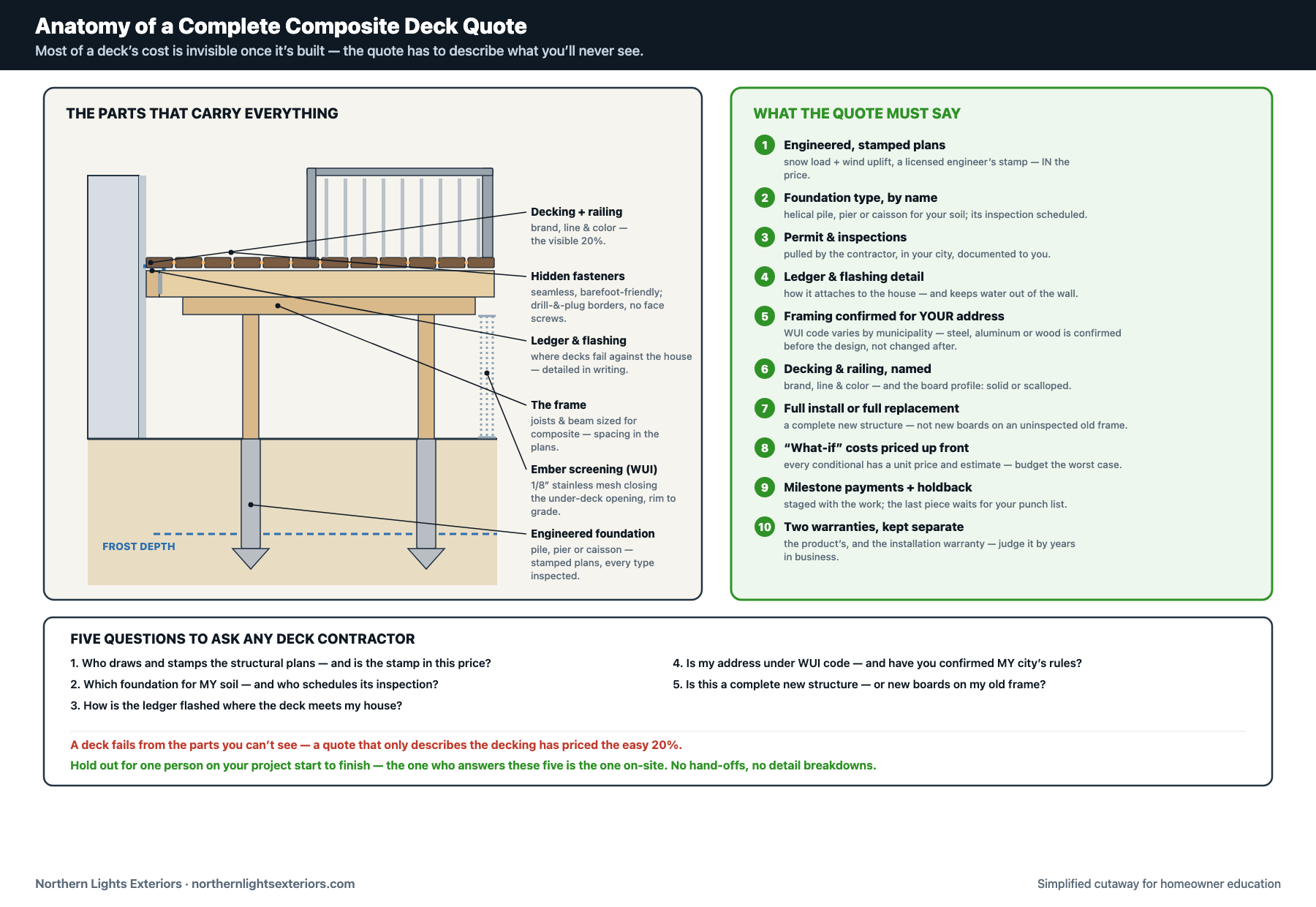
A complete composite deck quote includes engineered plans certified with a licensed engineer’s stamp, the foundation type by name with its required inspection, the permit, the ledger-and-flashing detail at the house, framing confirmed for your address, decking and railing named by brand and line, conditional costs priced up front, milestone payments, and both warranties. If a bid only describes the decking and the railing, it has priced the visible 20% of the project — the diagram below shows everything underneath that the quote has to commit to.
Why Deck Quotes Are Different
With a roof or siding, most of what you pay for is what you see. A deck is the opposite: the decking and railing are the finish on top of a structure — stamped plans, a foundation below frost depth, posts, beams, joists, and the connection to your house. Two bids for the “same” composite deck can sit far apart for exactly one reason: one of them priced that structure, and one of them didn’t.
That’s why comparing deck quotes by the decking brand alone never works. The brand tells you what the surface costs. The structure is where projects succeed, stall in permitting, or come back as change orders.
The Plans — and the Stamp
Along the Front Range and in the foothills, a deck is a structure with real loads on it: snow load, wind uplift, live loads at the railing. A complete quote starts with engineered plans certified with a licensed engineer’s stamp — drawn for your spans, your heights, and your jurisdiction’s requirements.
Two questions sort bids fast: “Who draws and stamps the structural plans?” and “Is the stamp in this price?” A contractor who builds engineered decks answers both in a sentence. A bid with no plans line is planning to improvise — or to add it later as a surprise.
The Foundation: Pile, Pier or Caisson
Colorado decks stand on one of three foundation types — helical piles, engineered pier systems, or drilled concrete caissons — and the right one is chosen by your soil and your structure, not by habit. Here is the part most homeowners never hear: every one of the three requires an inspection. Helical piles are verified with an installation report provided to the municipality on request; pier systems get a footing inspection; caissons are inspected per the municipality — open hole, concrete, or imaging.
So ask: “Which foundation for my soil — and who schedules its inspection?” The answer should name the type, the inspection, and the contractor as the one managing it. One practical note that belongs in any honest scope: utility locates ahead of foundation work are the homeowner’s responsibility — a complete quote says so up front instead of discovering it on dig day.
The Ledger: Where Decks Fail
Most attached decks fail at one detail: the ledger — the board that ties the deck to your house — and the flashing over it. Done right, water sheds past the connection and the wall stays dry for decades. Done with a bead of sealant where flashing belongs, water works into the wall and the rim framing, quietly, for years.
A complete quote describes the ledger attachment and the flashing detail in writing. If the bid doesn’t mention the word “flashing,” the third question on the diagram is the one to ask out loud: “How is the ledger flashed where the deck meets my house?”
Foothills & WUI: Never Assume the Code — Confirm It Per Address
If you’re in the foothills or a wildland-urban interface (WUI) area, the deck framing rules are not statewide — they vary by municipality, and counterintuitively, some WUI jurisdictions still allow wood framing while others do not. The position worth hiring for: the contractor confirms the code for your specific address before a design goes in front of you. A design drawn on the wrong assumption stalls in permitting and costs weeks of building season — and framing is not a late swap; changing it after the design is committed moves the price significantly. Non-combustible steel or aluminum framing is often the right recommendation on merit — it should never be sold as “the only thing allowed” without checking.
Two details complete the fire story. Composite lines with a Class A flame-spread rating are a material test result — but a Class A board over an unscreened cavity is not a Class A assembly: embers drift through board gaps, land under the deck, and burn upward. That’s why 1/8″ stainless ember mesh at every under-deck opening — continuous at the rim, stairs and skirting — belongs in the scope. And “WUI compliant” is a per-municipality call, not a product label — compliant in some jurisdictions, restricted in others. More in our WUI & fire-rated decks guide.
The Finishing: Where Workmanship Shows
Once the structure is right, the next tier of difference between deck bids is the finishing spec — and it hides in details most quotes never name. Four to look for:
- Board profile: solid vs. scalloped. Many composite lines save material by scalloping the underside of the board. Solid-profile boards are denser, carry more weight, flex less underfoot, and handle thermal movement better. The bid should name the profile — ask “is this board solid or scalloped?” and watch whether the answer comes easily.
- Fastening: hidden systems and drill-and-plug — not face screws. Top-down fasteners leave visible heads that can rust, create weak points where they penetrate the board, and “mushroom” the material around them. Hidden fastening keeps the surface seamless and barefoot-friendly with uniform spacing; where a border must be face-fixed, a drill-and-plug detail buries the screw under a plug of the same board.
- Picture-framed borders and stairs. A picture-frame border wraps the field boards so no cut end grain is exposed — cleaner lines, better weathering, and on stairs a visual contrast that is genuinely safer. Exposed end grain on the edges is the mark of a production build.
- Reading the decking spec itself. Composite lines differ on things the brochure glosses over: fire rating (Class A, B or C), the two warranty numbers (substrate and finish — they are often different), heat absorption (the barefoot test), and color range. A quote that names the exact line commits to all of those; “composite decking” commits to none of them.
None of these four costs much to say in writing — which is exactly why their absence from a bid says so much. They are the difference between a deck that was priced and a deck that was designed.
New Structure vs. New Boards on Old Bones
One more thing a complete quote declares plainly: whether it’s a complete new structure — full installation or full replacement — or new boards fastened to your existing frame. Re-boarding an old frame can look like a bargain, but it puts brand-new composite — and its long product warranty — on framing and footings nobody engineered, inspected, or warrantied. When that frame moves or rots, the new deck moves with it.
Ask the fifth question on the diagram and listen for a direct answer: “Is this a complete new structure — or new boards on my old frame?” Contractors who only take on complete structures will say so; contractors who re-board will have to explain who owns the old frame’s condition. Either way, now it’s in writing.
The Money Section: What-Ifs, Payments, Warranties
The same three commitments that mark a complete quote in any trade apply to decks. Conditional costs are priced before you sign — every “if needed” carries a unit price and an estimate, so you can budget the worst case on day one. Payments are staged to milestones with a holdback that waits for your punch list. And the two warranties stay separate: the decking manufacturer’s warranty ships with the product and survives no matter what happens to your contractor; the installation warranty is only as durable as the company behind it — judge it by years in business, not the word on the paper.
Composite Deck Quotes: Common Questions
What should a deck quote include?
Engineered plans certified with a licensed engineer’s stamp, the foundation type by name with its required inspection, permit responsibility, the ledger and flashing detail, framing confirmed for your address, decking and railing named by brand and line, fastener system, conditional costs with unit prices, a milestone payment schedule, and both the product and installation warranties in writing.
Do I need engineered plans for a deck in Colorado?
Most Front Range jurisdictions require a permit for a new deck, and many require stamped structural plans depending on size, height and attachment. Requirements vary by municipality — a contractor who builds decks in your city should confirm exactly what your address requires before designing, and the engineer’s stamp should be part of the quoted price, not an extra.
What is the best foundation for a composite deck?
The one your soil and structure call for — helical piles, an engineered pier system, or drilled concrete caissons each have their place. All three require inspection, so the better question for any bid is which type it names, why, and who schedules the inspection.
Can I just replace the deck boards and keep my old frame?
Mechanically it can be done — but it puts new composite decking on framing and footings nobody engineered or inspected, and the old frame’s condition becomes the project’s weakest link. A complete quote states plainly whether it prices a full new structure or a re-board, so you can compare like for like. Our own scope is full composite installations and full replacements only.
What is the difference between solid and scalloped deck boards?
Scalloped boards have material removed from the underside to cut cost and weight; solid-profile boards are denser, stiffer underfoot, carry more load, and respond better to temperature swings. Neither is a secret — but a quote that only says “composite decking” without naming the line and profile leaves the choice to whatever is on the truck. Ask for the profile by name.
Trex or TimberTech — which is better?
Both are premium composite systems, and we install both. The right line depends on the project — color and grain, railing system, budget tier, and site conditions — which is exactly the kind of recommendation that should come from your footprint and priorities, not from whichever single brand a contractor is set up to sell.
Is composite decking WUI compliant?
Some composite lines carry a Class A flame-spread rating, which is a material test result. WUI compliance is decided jurisdiction by jurisdiction — compliant in some municipalities, restricted in others — and a Class A board over an unscreened cavity is not a Class A assembly. Ember screening and framing requirements should be confirmed for your specific address before the design is drawn.
Who pulls the permit for a deck?
The contractor should — in your city, with the inspections scheduled and the paperwork documented to you. A quote with no permit line is a red flag in any trade, and doubly so for a structure with engineered loads.
I already have deck bids — will you look at them?
Yes. We give free, no-pressure second opinions on deck quotes — what’s priced, what’s missing under the boards, and which assumptions tend to become change orders.
A Deck Is Built Twice — Once on Paper, Once in Your Yard.
The paper version decides everything: stamped plans drawn for your loads, a foundation chosen for your soil, the code confirmed for your address before the design is committed. Northern Lights Exteriors builds full composite decks — Trex, TimberTech (TimberTech Silver Pro contractor since 2017) and Deckorators — with the finishing details above as our standard spec, not an upgrade: solid-profile boards, hidden fastening with drill-and-plug borders, picture-framed edges and stairs. Engineered, stamped plans, every inspection scheduled and documented to your client portal, and one dedicated project manager from first measurement to final punch list. Serving the Front Range since 2001. You build a deck once — it’s a lifestyle. Do it right. Already holding bids? Bring them — the second opinion is free.