
Colorado Hail Claim Deadlines: The 5 Windows That Cost Money
Colorado Claims Guide · Hail & Wind
Colorado Hail Claim Deadlines: Every Window That Can Cost You Money
A hail claim runs on five clocks — from the three business days you get to cancel a contract signed at your door, to the two-year statute of limitations. Two of the five live in your own policy, and those are the ones that expire first. Here is every window on a timeline, what starts each one, and the paperwork that protects you at every step.
Colorado’s statute of limitations gives you two years from the date of loss to bring suit on a denied or underpaid hail claim (C.R.S. § 13-80-102) — but your policy’s own deadlines come first: notice of loss is often required within one year (sometimes just “promptly”), and most policies require recoverable depreciation to be claimed within 180 days of the first payment. And if you signed a contract at your door, the FTC’s Cooling-Off Rule generally gives you three business days to cancel it. The practical rule: the policy clock beats the statute clock, and the depreciation clock is the one homeowners actually miss. The timeline below shows all four.
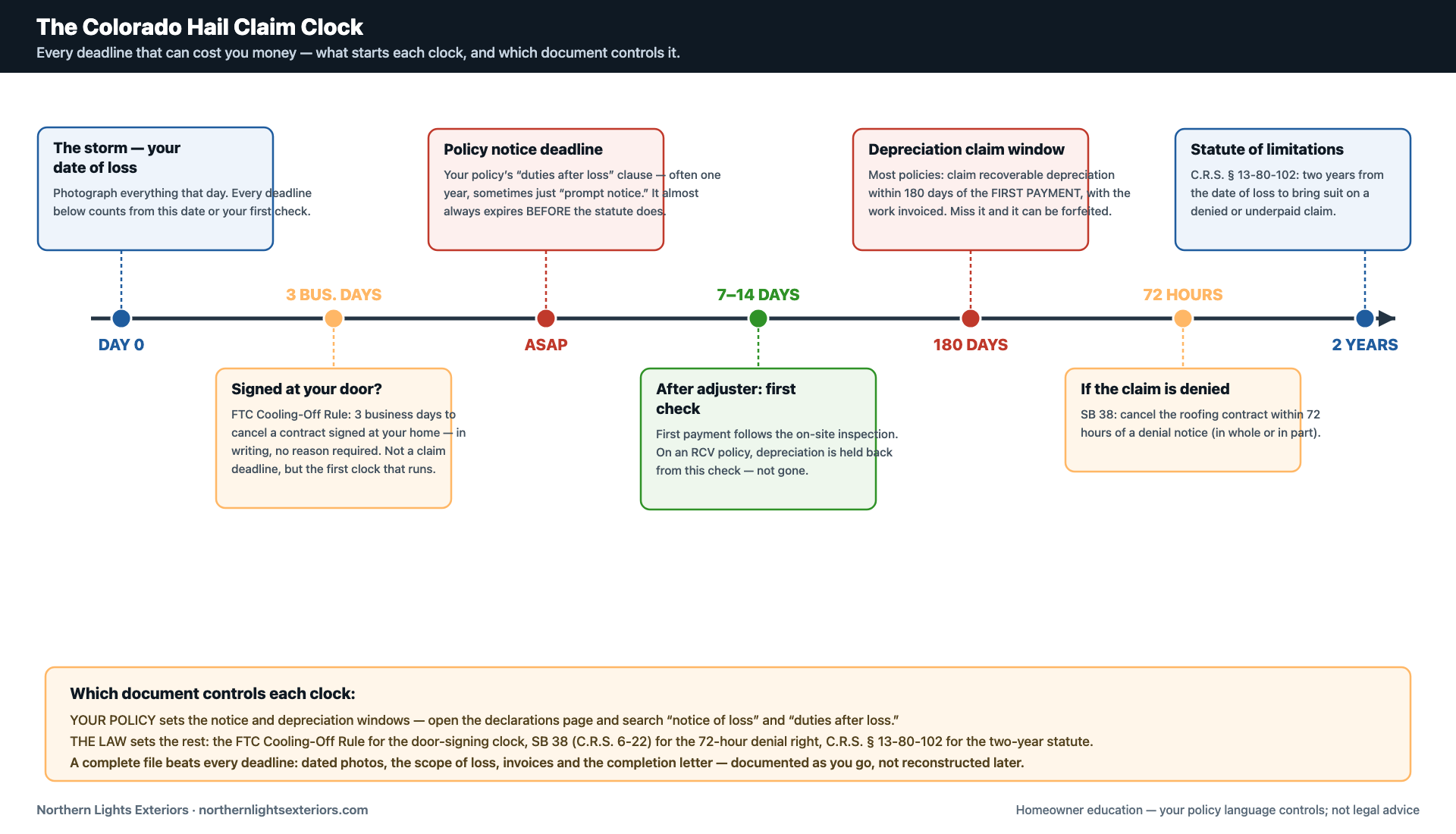
The Four Clocks, and Who Sets Them
Homeowners usually ask one question after a storm: “How long do I have to file?” The honest answer is that five different countdowns start around a Colorado hail claim, and they have different owners:
1. The door-signing clock — set by federal law. If you signed a contractor’s agreement at your home — anywhere other than the contractor’s permanent place of business — the FTC’s Cooling-Off Rule generally gives you three business days to cancel, and the contract is required to say so in writing. This is the clock that matters when a storm crew pushed a signature before you could do your homework.
2. The policy notice window — set by your insurer, in the “duties after loss” clause. Often one year from the date of loss; sometimes no fixed number at all, just “prompt notice.” This is almost always the first clock to expire.
3. The depreciation window — also set by your policy. On a replacement-cost (RCV) policy, the carrier holds back depreciation from the first check and releases it after the work is done and invoiced. Most policies require that depreciation to be claimed within 180 days of the first payment. Miss the window and the holdback — often many thousands of dollars — can be forfeited.
4. The 72-hour cancellation right — set by Colorado law. Under SB 38 (C.R.S. §§ 6-22-101 through 6-22-105), if your insurer denies the claim in whole or in part, you may cancel your roofing contract within 72 hours of that notice.
5. The statute of limitations — set by Colorado law: two years from the date of loss to bring suit on a denied or underpaid claim (C.R.S. § 13-80-102). This is the backstop, not the deadline to plan around — by the time it matters, every policy window above has long since closed.
Because two of the five clocks live in your policy, the first move after any storm is the same: open your declarations page and search for “notice of loss” and “duties after loss.” That one page outranks everything you will read on the internet, including this page.
Day Zero: Why the Date of Loss Is Worth Protecting
Every clock above counts from one of two moments: the date of loss (the storm) or the first payment. The date of loss matters most — and it is evidence, not a guess. Insurers match your claimed date against weather data, so the file should too: dated photos from the day of the storm, the NOAA hail report for your address, and an inspection report that ties the damage pattern to that event.
This is where a contractor’s real value on a claim shows up — and where the line between a contractor and a public adjuster matters. A contractor’s job is to document: photograph the damage, mark the hail hits, write the scope, supply the code citations and the invoices. Your insurer decides coverage, and only you (or a licensed public adjuster or attorney) can negotiate it. A complete, dated file beats every deadline on this page. Our free roof inspection produces exactly that file, before you ever call your carrier.
The 180-Day Trap: Recoverable Depreciation
The deadline Colorado homeowners actually miss is not the filing window — it is the depreciation release. The first RCV check arrives with depreciation held back, the roof gets built, and then life moves on. The invoice never goes in, the completion paperwork never gets sent, and 180 days later the holdback quietly expires inside the policy language.
What keeps that window: the work completed, the final invoice submitted to the carrier, and a completion letter documenting that the scope was performed. This is pure paperwork discipline — which is why every Northern Lights Exteriors claim project tracks it in the client portal: your scope of loss, photos, invoices, inspection records and completion documents live in one place, time-stamped, ready to submit the day the work is done rather than reconstructed months later.
One hedge worth repeating: 180 days is what most policies specify, counted from the first payment. Some allow longer; a few are shorter or tie the window to the date of loss. The number printed in your policy is the only one that counts.
If the Claim Is Denied: Two Rights With Short Fuses
A denial — in whole or in part — starts two clocks of its own. The short one is contractual freedom: under SB 38 you may cancel your roofing contract within 72 hours of being notified of the denial, which matters most when a contract was signed before the adjuster ever saw the roof. The long one is the courtroom backstop: two years from the date of loss under C.R.S. § 13-80-102 to bring suit on a denied or underpaid claim.
One distinction worth being precise about, because storm season blurs it: the 72-hour right above is triggered by a denial — nothing else. If you were pushed into signing at the door, slept on it, and your homework turned up a questionable reputation, an out-of-state operation, or just the feeling of having been maneuvered — the law built for that moment is the federal Cooling-Off Rule: three business days to cancel a contract signed at your home, in writing, no reason required. Our storm-chaser red flags guide covers the pressure tactics themselves; this is the exit built for them. Past three business days, the contract generally stands unless a denial opens the SB 38 window — which is exactly why the verification belongs before the signature.
Between those two extremes sits the ground where most denials are actually resolved: re-inspections, supplements with photos and code citations, and the Colorado Division of Insurance’s consumer complaint process. A denial built on an incomplete file is often reversible with a complete one — our Colorado hail claim guide walks that escalation path, and our guide to how roof claim supplements work covers the paperwork that reopens an underpaid scope. For disputes beyond documentation, the Division of Insurance and a licensed attorney are the right next calls — that is their lane, not a contractor’s.
Before the Storm: The Coverage to Check If You’re in a WUI Area
One more policy page worth reading today — though this clock is for foothills and mountain communities in mapped wildfire (WUI) areas, not for most plains homes, where hail does the damage and like-for-like replacement is usually the whole story. If you are in or near a WUI area, check your code upgrade coverage (listed as “Ordinance or Law” or “Coverage D — Building Code”). Colorado adopted a statewide wildfire resiliency code in 2025 — it applies in mapped WUI areas, not everywhere — and WUI jurisdictions have been rolling out their own versions since. In a mapped wildfire area, the storm-damaged roof or siding you replace may not be allowed back like-for-like: the code can require Class A fire-rated roofing assemblies, ignition-resistant siding, ember-resistant venting and related components, depending on what your jurisdiction has adopted.
Here is the gap: a standard policy pays to replace what you had, like for like. The difference between that and what the code now requires is paid by code upgrade coverage — a separate sublimit that many policies carry in token amounts or not at all. If the coverage is missing, the upgrade cost is yours, and on a WUI rebuild it can be a very large number. Two questions for your agent before the next storm: do I have Ordinance & Law coverage, and is the sublimit realistic for what my jurisdiction requires? Our Colorado Wildfire Resiliency Code guide explains what the code actually calls for — not every jurisdiction requires the same things, so we confirm the requirements for your specific address before any scope is written.
How We Keep Your Claim Inside Every Window
Northern Lights Exteriors has documented Colorado hail claims since 2001 — roofing, siding, windows and gutters on the same storm file. The system is built around the deadlines on this page: a free inspection that establishes the date-of-loss evidence before you file; a scope documented in Xactimate line items the adjuster can work with; and the client portal, where every photo, permit, invoice and completion document is time-stamped and ready the moment a window starts closing. We document — thoroughly, on time, in writing. Your insurer decides coverage, and the file we build makes that decision easy to make correctly. GAF Master Elite® roofing contractor · Class 4 impact-resistant shingles as our standard · one project manager start to finish.
Colorado Hail Claim Deadlines: Common Questions
How long do I have to file a hail claim in Colorado?
Two separate answers: Colorado’s statute of limitations is two years from the date of loss (C.R.S. § 13-80-102) for suing on a denied or underpaid claim — but your policy’s own notice deadline comes first, and it is often one year or simply “prompt notice.” Open your declarations page and search “duties after loss” — the policy clock is the one to plan around.
What is the deadline to collect recoverable depreciation?
Most policies require recoverable depreciation to be claimed within 180 days of the first payment, with the work completed and invoiced. Some policies allow longer and a few run shorter — the number in your own policy controls. It is the most commonly missed deadline on Colorado hail claims.
Does the two-year statute mean I can wait two years to file?
No. The statute is the deadline to bring suit, not to file a claim — and waiting invites a denial for late notice under your policy’s own terms, plus weathered-in damage that is harder to tie to the storm. File promptly with a documented date of loss; treat the statute as the backstop it is.
What starts the 72-hour cancellation right?
Notice that your insurer has denied the claim in whole or in part. From that notice, Colorado’s SB 38 (C.R.S. 6-22-101 through 6-22-105) gives you 72 hours to cancel a roofing contract tied to that claim — and the contract itself is required to state that right in writing.
Can my contractor negotiate my claim with the insurance company?
No — and be wary of one who offers to. In Colorado, negotiating a claim on your behalf is the regulated work of a licensed public adjuster or an attorney. A contractor’s proper role is documentation: the inspection report, photos, measurements, code citations, line-item scope and invoices that let your insurer get the decision right. That is the role we play, and the file usually does the arguing on its own.
What documents should I keep for each deadline?
Dated storm-day photos and the NOAA hail report (date of loss) · your claim number and the full scope of loss (filing) · the final invoice and a completion letter (depreciation release) · every denial or payment letter with its date (the 72-hour and two-year clocks). On our projects, all of it lives time-stamped in your client portal.
I was pressured into signing a contract at my door — can I cancel?
Generally yes, within three business days: the FTC’s Cooling-Off Rule applies to contracts signed at your home or anywhere other than the seller’s permanent place of business, and the contract must include written notice of that right. Put the cancellation in writing inside the window. After that, SB 38’s 72-hour right only opens if your insurer denies the claim — it is not a general escape hatch, which is why checking a company out before signing matters so much.
Does insurance cover wildfire code upgrades in WUI areas?
Not by default — only through code upgrade coverage (“Ordinance or Law”), a separate sublimit many policies minimize or omit. Colorado’s wildfire resiliency code means WUI-area rebuilds, not typical plains rebuilds, may be required to use Class A fire-rated and ignition-resistant materials that the standard “like kind and quality” payment does not cover — the gap is yours unless that coverage is in place. Requirements vary by jurisdiction; ask your agent about the sublimit, and confirm what your address requires before a scope is written.
Do these deadlines apply to siding, windows and gutters too?
Yes — the policy windows (notice and depreciation) apply to the whole property claim, not just the roof. SB 38’s 72-hour cancellation right is specific to roofing contracts, but hail claims in Colorado routinely include siding, windows, gutters and paint, and the same date-of-loss documentation covers every trade on the file.
The Deadlines Are Fixed. The File Is Up to You.
Every window on this page is easier to meet with a complete, dated file than with a scramble. Northern Lights Exteriors starts every Colorado storm claim with a free inspection that documents your date of loss, and runs the whole project — scope, photos, permits, invoices, completion letter — through your client portal, time-stamped and ready before any clock runs out. Roofing, siding, windows and gutters on one file, one project manager start to finish, since 2001. And if a storm crew is pressuring you to sign tonight: the deadlines above are measured in months and years, not minutes.