
What Should a Roofing Estimate Include? Anatomy of a Legitimate Quote
Homeowner Decision Guide · Roofing
The Line Items a Legitimate Colorado Roofing Quote Carries
An annotated sample of a complete Colorado roofing estimate — the ten line items that must be in writing, why each one decides how the job goes, how to compare two bids apples to apples, and the four red flags that mean walk away.
A complete roofing estimate itemizes at least ten things in writing: tear-off and disposal, the underlayment by product name, ice & water shield, drip edge, the exact shingle (brand, product line, impact class, and squares), ridge caps, ventilation, flashing, the building permit, and a written installation warranty. If a bid is one number on one line, you have nothing to compare and nothing to hold the contractor to. The diagram below shows what a legitimate quote looks like — line by line.
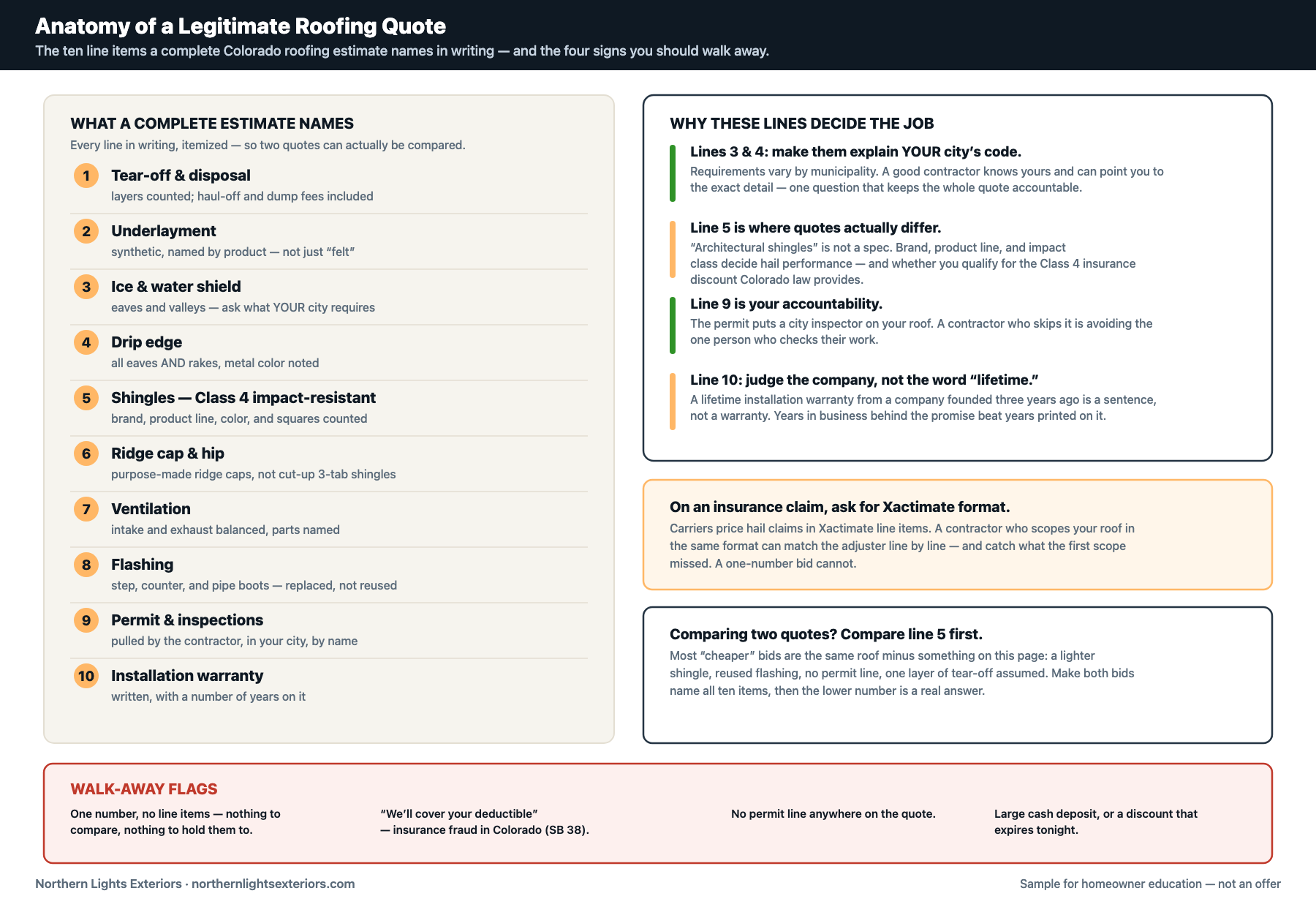
The Ten Line Items, One by One
Two roofing bids can only be compared if both of them say what they include. These are the lines a complete Colorado estimate names — and what each one is quietly deciding about your roof.
| # | Line item | What it should say | What it decides |
|---|---|---|---|
| 1 | Tear-off & disposal | How many layers come off; haul-off and dump fees included | Whether the deck gets inspected, and whether a surprise second layer becomes a change order |
| 2 | Underlayment | Synthetic, named by product — not just “felt” | The only water barrier between storms during the build, and the backup layer for the life of the roof |
| 3 | Ice & water shield | At eaves and valleys, named by product | Often required by municipal code — ask the contractor to explain what your city requires (see below) |
| 4 | Drip edge | All eaves and rakes, metal color noted | Protects the fascia and deck edge your gutters hang from; another spec your city’s code speaks to |
| 5 | Shingles | Brand, product line, color, impact class, squares counted | Hail performance — and eligibility for Colorado’s Class 4 insurance-premium discount (C.R.S. 10-4-110.8) |
| 6 | Ridge cap & hip | Purpose-made ridge caps | Cut-up 3-tab shingles on a ridge are the first thing Colorado wind peels off |
| 7 | Ventilation | Intake and exhaust, balanced, parts named | Deck temperature — which is to say ice dams in winter and shingle life in summer |
| 8 | Flashing | Step, counter and pipe boots — replaced, not reused | Where roofs actually leak; reused flashing is where cheap bids hide |
| 9 | Permit & inspections | Pulled by the contractor, in your city, by name | The one person who independently checks the work is the city inspector the permit buys you |
| 10 | Installation warranty | Written, with a number of years on it | The manufacturer covers the shingle; only this line covers the installation — and it is only as good as the company’s longevity |
One question worth asking about lines 3 and 4: “What does my city’s code require here — and can you show me?” Code requirements for items like ice & water shield vary by municipality along the Front Range, and a good contractor knows the requirements where you live and can point you straight to the detail. It is one extra step, and it is a filter: sales teams built for speed get visibly annoyed by it — and a crew that can’t explain your city’s code today is the same crew that won’t be around when a question comes up in year three.
How to Compare Two Roofing Quotes
Start at line 5. Most “cheaper” bids are the same roof minus something on the list above — a lighter, non-impact-rated shingle, reused flashing, no permit line, or one assumed layer of tear-off. “Architectural shingles” is not a specification; brand, product line and impact class are.
The fix is simple and fair to everyone: ask both contractors to re-issue their bids naming all ten items. A professional estimator already works this way and will not hesitate. Once both bids name the same scope, the lower number is a real answer — and sometimes it is genuinely the better bid.
One comparison trap worth knowing: a quote priced per “square” (100 sq ft of roof) can hide a low squares count that grows later. The estimate should state the measured squares and the waste factor, so the quantity is fixed before the price is.
On an Insurance Claim, Ask for Xactimate Format
Colorado hail claims are priced by carriers in Xactimate — line-item estimating software that names every component, quantity and unit price. A contractor who scopes your roof in the same format can be matched against the adjuster’s scope line by line, and can document a supplement when the first scope missed items your municipality’s code requires. A one-number bid cannot do any of that.
One more thing a legitimate quote will never do on an insurance job: absorb your deductible. Under Colorado’s SB 38, a roofing contractor who pays, waives or rebates an insurance deductible is committing insurance fraud — and inviting you to participate. Our Colorado hail damage insurance claim guide covers the whole process, from documentation to supplements.
What the Number at the Bottom Should Look Like
Most Colorado homes land between $7,600 and $11,900 for a Class 4 impact-resistant asphalt roof — roughly $380–$475 per roofing square — with premium systems like standing-seam metal running higher. The full breakdown, including what moves the number and a cost calculator, is on our Colorado roof replacement cost guide. If a bid lands far below that range, the list above is usually where the difference is hiding.
The “Lifetime Warranty” Trap
Plenty of roofing companies sell a lifetime installation warranty without having been in business ten years — let alone twenty-five. A installation warranty is not a product; it is a promise that the company will still exist, still answer the phone, and still put a crew on your roof years from now. The word “lifetime” on a three-year-old letterhead doesn’t change any of that.
Here is how it plays out along the Front Range: a few storm seasons stack up, the warranty queue at a high-volume shop grows, and homeowners wait weeks or months for warranty service on a problem that a reputable local company would fix promptly — often a straightforward roof repair in the $500–$1,000 range. The “free” warranty visit that never gets scheduled is more expensive than the prompt repair that does.
The practical test takes one question: “How long have you been in business under this name?” Then weigh the warranty against the answer. A written 5-year installation warranty from a company with 25 years of Colorado history is worth more than a lifetime promise from a company younger than your water heater.
The Walk-Away Flags
Four things on a roofing quote — or in the conversation around it — that should end the conversation:
- One number, no line items. Nothing to compare, nothing to hold them to.
- “We’ll cover your deductible.” Insurance fraud in Colorado (SB 38) — and a preview of how they treat paperwork.
- No permit line. A contractor avoiding the city inspector is avoiding the one independent check on their work.
- A large cash deposit or a discount that expires tonight. Legitimate pricing survives a night’s sleep.
If several of these flags arrived together at your door after a hailstorm, the pattern has a name — our storm-chaser red flags guide walks all eight tells, including why storm crews only want the roof.
If the contractor also can’t show a local license, insurance certificate or verifiable manufacturer credential, use our companion guide: how to verify a Colorado roofing contractor in five checks.
Roofing Estimate Questions, Answered
What should a roofing estimate include?
At minimum: tear-off and disposal with layers counted, underlayment by product name, ice & water shield, drip edge, the exact shingle (brand, line, impact class, squares), ridge caps, ventilation, flashing, the permit, and a written installation warranty — each as its own line, in writing.
How many roofing quotes should I get?
Two or three is plenty — if they are itemized. Ten one-number bids tell you less than two complete ones. Make every bidder name the same ten items and the comparison does itself. One exception: on an insurance claim the insurer pays the scope it approves, so collecting competing bids mostly helps the insurer — there, the real decision is which company you trust to represent the whole claim.
Why do roofing quotes vary so much?
Because they rarely price the same roof. The spread usually lives in the shingle line (impact class), flashing (replaced vs. reused), tear-off assumptions, and whether a permit and real warranty are included at all.
Is the cheapest roofing quote ever the right choice?
Sometimes — when it names the same complete scope as the others. A lower number on an identical, fully itemized scope is a better bid, not a red flag. The flag is a lower number that cannot say what it includes.
Should a roofing estimate include the permit?
Yes, as its own line, pulled by the contractor in your city’s name. Colorado licensing and permitting run city by city, and the permit is what puts an independent inspector on your roof.
What is Xactimate, and why does it matter on a claim?
Xactimate is the line-item estimating platform insurance carriers use to price hail claims. A contractor who scopes in the same format can reconcile against the adjuster line by line and document supplements for missed code items.
Is a lifetime installation warranty better than a 5-year one?
Only if the company lives that long. A installation warranty is a promise the business will still exist when you need it, so judge the years in business, not the years on the paper — a 5-year warranty from a 25-year company beats a lifetime warranty from a 3-year company. And if you are holding a warranty nobody honors, a prompt repair from a reputable local company typically runs $500–$1,000 — usually cheaper than the wait.
Do you charge for estimates?
No — inspections and estimates are free, and we will tell you when a roof does not need replacing. Every Northern Lights Exteriors estimate is line-item as a standard, so you can compare it against anyone’s.
Want a Quote Built Like the Diagram?
Every Northern Lights Exteriors estimate is written line-item — tear-off to warranty — with Class 4 impact-resistant shingles as our standard, a dedicated project manager on every job, and your documents kept in your client portal. GAF Master Elite®, serving the Front Range since 2001. Compare us against anyone.