
How to Compare Siding Quotes: The Same House, Three Different Bids
Homeowner Decision Guide · Siding
Three Bid Types, One House: What Each Quote Hides
Most siding-quote confusion isn’t about price — it’s about comparing documents that aren’t the same kind of document. Three bid archetypes from real Colorado quotes (anonymized), the five questions that expose an incomplete one, and the sales tactic that answers everything.
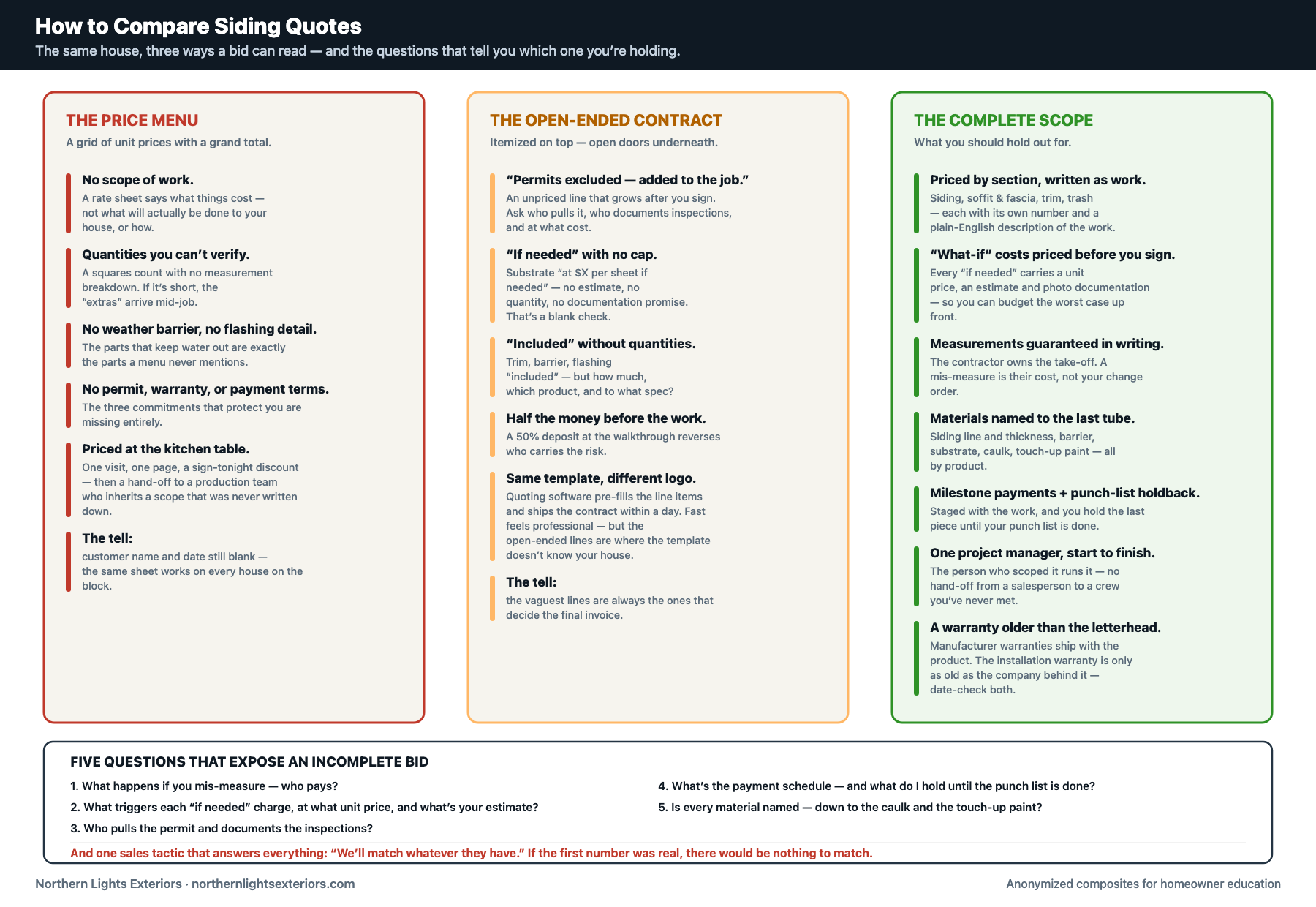
To compare siding quotes, first make them comparable: a complete bid prices each section as described work, names every material by product, discloses each conditional cost with a unit price and an estimate, guarantees its own measurements, and stages payments with a punch-list holdback. Most “cheap” bids aren’t cheaper — they are a different document type: a rate sheet, or a contract with open-ended lines. The diagram below shows all three side by side.
Archetype 2: The Open-Ended Contract
The second document is better — genuinely. It names the product line, the colors, even the weather barrier. The problem lives in the handful of lines that aren’t numbers:
- “Permits excluded — costs/fees will be added to the job.” An unpriced line that grows after you sign, with no commitment about who pulls the permit or documents inspections.
- “Substrate, if needed: $X per sheet.” No estimate, no expected quantity, no promise to document what was found. On a re-side, “if needed” is often “when needed” — this is the line the final invoice is made of.
- “Included” without quantities. Trim “included.” Flashing “included.” How much, which product, to what specification?
- Half the money before the work. A 50% deposit at the walkthrough moves the project’s risk onto you before a single plank comes off the wall.
None of these makes a contractor dishonest. But each one is a decision deferred until after you’ve signed — and deferred decisions are always priced in the contractor’s favor.
This document has a mechanism too. It comes out of quoting software — often the same backend platform across many companies, which is why these contracts look nearly identical from one logo to the next. The line items are pre-filled from a rate database and the contract lands in your inbox the same day, sometimes within the hour. It is built for a specific buyer: someone who is genuinely ready to go, but allergic to the sign-while-I’m-sitting-at-your-kitchen-table approach. The speed feels like professionalism — and the template is exactly why the document reads itemized while leaving the house-specific decisions (your substrate, your permit, your quantities) open-ended. The software has never seen your house.
The question that sorts it: “Which of these lines were written about my house — and which came with the template?” A contractor who measured, photographed and scoped your home can answer line by line. A template can’t.
Archetype 3: The Complete Scope
The third document reads differently from the first sentence: it describes work, not rates. Each section — siding, soffit and fascia, trim, even trash handling — carries its own price and a plain-English description of what will be done, down to blocking the penetrations and what happens to leftover material.
Notice how much of it is “what-if” language — and that this is a feature, not hedging. What’s under the old siding genuinely can’t be known until tear-off, so a complete scope prices the scenarios before you sign: if the substrate needs replacing, here’s the unit price and our estimate; if rot turns up at a window, here’s what that costs and how we’ll document it. You can budget the worst case on day one instead of discovering it on day four. That kind of scope is also where experience shows — the what-if lines only get written by a company that has opened enough Colorado walls to know what tends to be behind them. A template can’t anticipate your house; twenty-plus years of tear-offs can.
Five commitments separate it from the other two, and they are worth holding out for from any contractor:
- Conditional costs disclosed up front — every “if needed” item carries a unit price, an estimated total, and a promise to document the condition with photos before charging for it.
- Measurements guaranteed in writing — the contractor owns the take-off quantities; a mis-measure is their cost, not your change order.
- Materials named to the last tube — siding line and thickness, barrier, substrate, caulk, touch-up paint. If it will touch your house, it has a name.
- Milestone payments with a punch-list holdback — money staged as the work lands, and the final piece stays in your pocket until your punch list is complete.
- One project manager, start to finish — the person who scoped the project runs the project. The best-run jobs are never the ones handed from a commissioned salesperson to a production team you’ve never met; they’re the ones where the name on the estimate is the name on-site at the punch list.
The Price-Match Tell
One more pattern worth knowing, because it usually appears right when you mention a competing bid: “We’ll match whatever they have.”
Think about what that sentence admits. If the first number was real — built from measurements, material takeoffs and labor — there would be nothing to match; the number would simply be the number. A company whose price can drop 15% the moment you mention a competitor is telling you the original quote carried 15% of air. Good contractors will walk you through why two bids differ, line by line. Price-matching skips the explanation and keeps the vagueness — which, as the archetypes above show, is where the real cost lives.
The “Lifetime Warranty” Line
The price-match offer has a sibling, and it shows up in the same conversation: the lifetime installation warranty. In a siding market this competitive, “lifetime” costs nothing to print — especially for a company that hasn’t been in business ten years, let alone twenty. A installation warranty is a bet that the company will outlive the promise; the word on the paper doesn’t change the odds.
Keep the two warranty types separate when you compare bids. The manufacturer’s warranties — on fiber cement substrate and factory finish — come with the product and survive no matter what happens to your contractor. The installation warranty covers the work itself, and it is only as durable as the company behind it. So add a sixth question to the five below: “How long have you operated under this name?” — then weigh the warranty against the answer. Ten written years from a twenty-five-year company beats a lifetime promise from a letterhead younger than your water heater.
The Five Questions, and Why They Work
You don’t need to be a construction expert to sort bids — you need five questions that complete documents answer easily and incomplete ones can’t:
- “What happens if you mis-measure — who pays?” A contractor who guarantees quantities already measured carefully. One who hesitates is planning to measure on your dime.
- “What triggers each if-needed charge, at what unit price, and what’s your estimate?” Honest conditionals have numbers before the work starts, not after.
- “Who pulls the permit and documents the inspections?” The answer should name the contractor, and come with paperwork to you.
- “What’s the payment schedule — and what do I hold until the punch list is done?” Milestones aligned to work protect both sides; a half-down deposit protects one.
- “Is every material named — down to the caulk and touch-up paint?” Specific products can be verified, warrantied and matched later. “Premium materials” cannot.
Like the question about your city’s code requirements on a roofing quote, these work as a filter: sales teams built for speed get visibly impatient with them — and that impatience is the answer.
What Siding Actually Costs in Colorado
Once the bids are comparable, the numbers have context: James Hardie fiber cement typically runs $10–$18 per square foot installed along the Front Range, with full-home replacements commonly landing between $20,000 and $60,000+ depending on size, stories, substrate condition and trim detail. The full breakdown by material is in our Colorado siding cost guide, and the siding Q&A hub answers the material-by-material questions.
Comparing Siding Quotes: Common Questions
What should a siding quote include?
Section-by-section pricing written as described work (siding, soffit and fascia, trim, disposal), every material named by product, the weather-resistive barrier and flashing spelled out, conditional costs with unit prices and estimates, permit and inspection responsibility, warranty terms in years, and a milestone payment schedule.
Why do siding quotes vary so much?
Usually because they are different document types, not different prices for the same job. A unit-rate menu, a partially itemized contract and a complete scope can carry similar totals while committing to very different amounts of work — the variation lives in what each one doesn’t say.
Is a 50% deposit normal for siding work?
It is common; that doesn’t make it good practice. A payment schedule staged to milestones — signing, material delivery, substantial completion — with a final holdback until your punch list is complete keeps both sides invested in finishing well.
What does “if needed” mean on a siding bid?
It flags real uncertainty — substrate condition under old siding genuinely can’t be known until tear-off. The difference between honest and open-ended is disclosure: a unit price, an estimated quantity, and photo documentation of the condition before it is charged.
How do I know the measurements on a bid are right?
Ask who is responsible if they aren’t. A contractor who guarantees their take-off quantities in writing has answered the question; one who leaves quantities soft has pre-sold their change orders.
Should I take a price-match offer?
Treat it as information. A real price is built from measurements and materials and doesn’t move when a competitor is mentioned. Ask the contractor to explain the difference between the two bids line by line instead — the explanation is worth more than the discount.
Is a lifetime siding warranty worth anything?
Split it in two. Manufacturer warranties — substrate and factory finish — come with the product and hold regardless of the installer. A “lifetime” installation warranty is a promise about the company’s own future: from a contractor with decades in business it means something; from one founded three years ago it is marketing. Judge the years behind the warranty, not the years printed on it.
Does it matter who manages the project after I sign?
More than almost anything else on the quote. Ask who, by name, runs your project from estimate through punch list. The best-run projects have one project manager start to finish — the person who scoped the work oversees the work. If the answer is a hand-off from the salesperson to “production,” the scope gaps become your problem to negotiate with someone who never saw your house before the crew showed up.
I already have quotes — will you look at them?
Yes. We do free, no-pressure second opinions on siding quotes — what’s included, which assumptions tend to become change orders, and how the installation would actually be executed.
You’ve Waited Twenty Years for New Siding. The Quote Should Be Worth It.
Most homes get new siding once in twenty-plus years — a quote built from your actual house is worth the few extra days it takes. Northern Lights Exteriors estimates are written as a true custom scope of work: measured and photographed on-site, priced section by section, materials named to the last tube, conditional costs disclosed with unit prices and estimates, measurements guaranteed in writing, and milestone payments with a punch-list holdback — with the “what-if” scenarios priced before you sign, so there are no surprises and you can budget the whole project from day one. One dedicated project manager runs your job start to finish, and we’d rather educate you on every option than push you toward a quota — because a well-educated client is the happiest client in the end. James Hardie Elite Preferred™ since 2011 and President’s Club, serving the Front Range since 2001. Already holding quotes? Bring them — the second opinion is free.